In modern buildings, especially those handling sensitive projects and critical data, access security plays a critical role in protecting people, assets, and information. Controlling who can enter specific areas is no longer optional but essential for operational safety and risk management.
Access security becomes more effective when integrated into a complete smart building solution. Connected systems enable real-time monitoring, automated responses, and centralized control, transforming traditional access control into a proactive and intelligent security layer that adapts to dynamic environments.
This blog explores access security in smart buildings, its importance in the UAE, key benefits, essential systems, integration capabilities, and how it compares to traditional access methods.
Why Access Security in Smart Buildings Is Vital in the UAE?
The UAE’s fast urban development, high-value properties, and growing focus on data protection have increased the need for effective access security and raised expectations across all sectors. Businesses and property developers must comply with strict regulations while ensuring safety, operational continuity, and advanced protection standards across modern buildings.
In multi-tenant environments, smart access security ensures controlled entry for residents, employees, and visitors while maintaining privacy, reducing risks, and improving overall operational efficiency.
What Is Access Security in Smart Buildings?
Access security in these environments refers to the use of smart solutions and IoT technologies to control, monitor, and manage entry to physical and digital spaces, ensuring only authorized individuals can access specific areas while maintaining real-time visibility and security control.
It combines physical and digital access through authentication, authorization, and continuous monitoring, creating a secure environment where access permissions are managed effectively. Smart access security delivers manageable and adjustable access levels based on project or time requirements.
Types of Access Control Technologies in Smart Buildings
Access control in smart buildings relies on different technologies to verify identity and manage entry efficiently. Each technology offers a different level of security, flexibility, and user experience depending on building requirements.The main types are:
- RFID and card-based access.
- Biometric access control.
- Mobile-based access.
- Cloud-based access control.
RFID and Card-Based Access
RFID and card-based systems use physical cards or keys to grant access. They are widely used due to their simplicity, but they can be limited by risks such as loss, duplication, or unauthorized sharing.
Biometric Access Control
Biometric systems use unique physical traits such as fingerprints, facial recognition, or iris scans to verify identity. This technology provides a higher level of security and reduces the risk of unauthorized access.
Mobile-Based Access
Mobile-based access allows users to unlock doors using smartphones or digital credentials. It offers flexibility, remote management, and eliminates the need for physical cards or keys.
Cloud-Based Access Control
Cloud-based systems enable centralized access management through online platforms. They allow real-time monitoring, remote control, and seamless integration with other smart building systems.
Access Security vs Access Control: What’s the Difference?
Access control focuses on managing permissions, while access security represents a complete ecosystem that includes monitoring, protection, and response mechanisms to ensure full building safety.
| Feature | Access Control | Access Security |
| Core Function | Manages who can enter | Manages, monitors, and protects access |
| Scope | Permissions only | Full security ecosystem |
| Visibility | Limited tracking | Real-time monitoring and visibility |
| Integration | Standalone systems | Integrated with smart building systems |
| Response | Manual actions | Automated security responses |
| Purpose | Entry management | End-to-end security and protection |
Benefits of Access Security in Smart Buildings
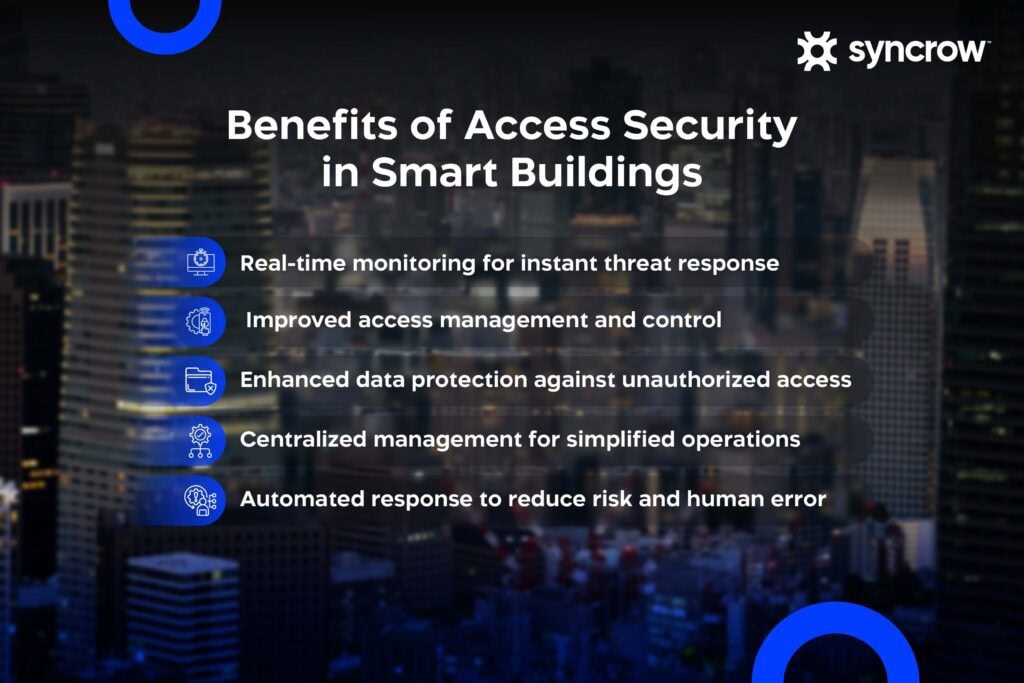
Security systems in smart buildings provide several benefits that help maintain operational efficiency while ensuring data security. Smart access has high value in facilities handling sensitive projects and in buildings occupied by multiple companies, maintaining both security and ease of access. The key benefits of smart access security are:
- Real-time monitoring for instant threat detection and response.
- Improved access security management for better control and accountability.
- Enhanced data protection to prevent unauthorized access and breaches.
- Centralized management for simplified security operations.
- Automated response to minimize risk and human error.
Real-Time Monitoring for Instant Threat Detection and Response
Continuously tracks access activity across all entry points, allowing security teams to detect unauthorized attempts instantly and respond quickly before threats escalate into serious incidents. Real-time monitoring in such environments can trigger instant alarms and actions when breaches occur.
Improved Access Security Management for Better Control and Accountability
Enables administrators to handle permissions efficiently, ensuring only authorized individuals have access to specific areas while maintaining detailed logs for accountability and compliance. Unauthorized access is minimized in a smart building, as IDs, cards, or fingerprints are linked to automated access levels.
Enhanced Data Protection to Prevent Unauthorized Access and Breaches
Restricts access to sensitive areas such as server rooms, project laboratories, and control centers, reducing the risk of data breaches and protecting critical business information. Installing smart access security is vital for data protection in large buildings where many people need daily access.
Centralized Management for Simplified Security Operations
Modern smart access security systems provide a unified platform to monitor and control all access points, simplifying operations and improving visibility across the entire facility. This access control platform shows all access levels, including permissions, and logs of movements within the facility which is highly important in a hybrid workspace.
Automated Response to Minimize Risk and Human Error
Smart access security can trigger pre-set automatic actions like locking doors or sending alerts when suspicious activity is detected, including forced entry attempts and physical impacts, ensuring faster and more reliable responses without relying solely on manual intervention.
Key Access Security Systems in Smart Buildings
Different smart access security systems are integrated to establish a reliable and strong security system across the facility. Smart solutions ensure better access coordination and a higher level of security when these systems are professionally integrated:
- Smart door locks
- Visitor management systems
- Alarm systems
- Biometric access control
- Mobile-based access
Smart Door Locks
Smart door locks provide secure, keyless entry using PIN codes, fingerprints, face ID, or mobile apps, enhancing convenience while ensuring only authorized individuals can access specific areas. Smart locks provide seamless and efficient movement management, especially when integrated with smart solutions.
Visitor Management Systems
These systems streamline visitor registration, track entry and exit, and ensure controlled access, improving both security and the overall visitor experience. Visitor management systems allow temporary access to specific points based on current requirements without the need to give permanent access or physical keys to visitors.
Alarm Systems
Alarm systems detect unauthorized access attempts and trigger alerts in real time, enabling immediate response to potential security threats and enhancing overall building protection. These alarm systems can be connected to external security systems, such as central monitoring facilities or police stations to provide support when needed.
Biometric Access Control
Biometric systems use fingerprints, facial recognition, or iris scans to verify identity, providing a high level of security and eliminating risks associated with lost or shared credentials. This access control system is typically applied to areas with highly critical information, not to the entire building.
Mobile-Based Access
Mobile access allows facility managers and security teams to unlock doors when needed using smartphones, offering flexibility, remote control, and seamless integration with other smart building systems. This remote access provides greater control over entry and avoids the need to share permanent permissions.
How Access Security Systems Work in Smart Buildings
Smart access security systems operate through a structured and automated flow that ensures only authorized individuals can enter and every action is tracked in real time.
Authentication
The system first identifies the user using credentials such as biometrics, mobile access, PIN codes, or access cards.
Verification
The system then verifies the credentials against predefined access permissions to confirm whether entry is allowed.
System Trigger
Once verified, the system triggers the required action such as unlocking doors, granting access, or activating connected smart systems.
Logging
Every access attempt is recorded in real time, creating a complete log of entries, exits, and system activity for monitoring and accountability.
ROI of Smart Access Security
Smart access security is not just a safety upgrade, it delivers measurable operational value across building management.
- Reduced manpower for security operations through automation and centralized control.
- Fewer security breaches by enabling real-time monitoring and controlled access permissions.
- Improved operational efficiency by streamlining access management across all building areas.
How Access Security Integrates with Smart Building Systems
Efficient compatibility and integration of smart access security leads to better security and control across all building sections while reducing the risk of system failure. When integrated with smart building solutions, access security systems provide better control and trigger other systems to protect the building and company data.
Smart Cameras
Smart cameras provide real-time video monitoring and integrate with access systems to verify identities and record entry events for enhanced security visibility.
Smart Motion Sensors
Smart sensors detect movement in restricted areas and trigger alerts or automated actions, helping identify unauthorized access quickly.
Smart Shock Sensors
Shock sensors detect forced entry attempts such as door tampering or break-ins, enabling early warning and immediate response.
Smart Hubs
Smart hubs act as central controllers, connecting all devices and enabling seamless communication between access control systems and other smart building technologies.
Smart Access Security vs Card Access Security: Which Is Better?
Access security management is vital for buildings and facilities, especially those for large corporations or multiple companies. Access control allows only the people who should be there to enter. Smart access security provides modern and efficient access for people and multi-level access control in each company and department.
| Feature | Smart Access Security | Card-Based Access |
| Data Protection | High, encrypted and monitored | Limited, disposed to loss or duplication |
| Access Control | Dynamic and customizable | Static and less flexible |
| Flexibility | Remote and mobile-based access | Requires physical cards |
| Scalability | Easily scalable across systems | Limited scalability |
| Building Safety | Integrated with automation systems | Standalone functionality |
| System Integration | Fully integrates with smart systems | Limited integration |
| Cybersecurity Risk | Managed with advanced protocols | Lower digital risk but higher physical risk |
Who Needs Smart Access Security the Most?
Smart access security is an essential IoT solution for organizations and property managers who require high levels of control, safety, and operational efficiency. It is particularly valuable in environments with multiple users, sensitive data, or high security expectations.
The key idea of smart access security is allowing people to access only the areas they are authorized to enter while allowing authorized people to enter without conflict or delay.
- Residential towers for efficient tenant management, controlled entry, and improved residential safety.
- Offices for employee access control, operational efficiency, and data security protection.
- Hotels for structured guest access management, room-level control, and secure service operations.
- Gated communities for resident safety, visitor regulation, and controlled community access.
Conclusion
Access security in smart buildings is no longer a standalone function, it is most effective when integrated across multiple systems to ensure full visibility, control, and operational efficiency. Businesses are now shifting from isolated solutions to connected environments that unify access, monitoring, and automation.
This is where Syncrow platforms deliver value as a centralized platform and multi-system connector, enabling seamless coordination across all building technologies. Syncrow helps organizations achieve smarter access control, improved safety, and higher operational performance through one unified and intelligent building management ecosystem. Find out all about the suitable smart solution for your building with our free consultation.
FAQs About Access Security
What Is Smart Access Control in Buildings?
Smart access control uses connected technologies to manage and monitor entry points, allowing authorized individuals to access specific areas while providing real-time visibility and control over building security.
What Is Meant by Access Security?
Access security refers to the systems and processes used to control who can enter physical or digital spaces, ensuring only authorized individuals gain access while maintaining safety and protection.
What Are the 4 Types of Access Security?
The four types include discretionary access control, mandatory access control, role-based access control, and attribute-based access control, each offering different levels of flexibility and security.
What Are the 5 Steps of Access Security?
The five steps include identification, authentication, authorization, access, and monitoring, ensuring secure and controlled entry while maintaining visibility over all access activities.
What Is the Difference Between Access Control and Access Security?
Access control focuses on managing permissions and entry, while access security includes broader measures such as monitoring, protection, and response to ensure overall safety.
Is Smart Access Security Safe?
Yes, smart access security is safe when properly implemented, using encryption, authentication, and monitoring to protect against unauthorized access and ensure secure operations across the building.