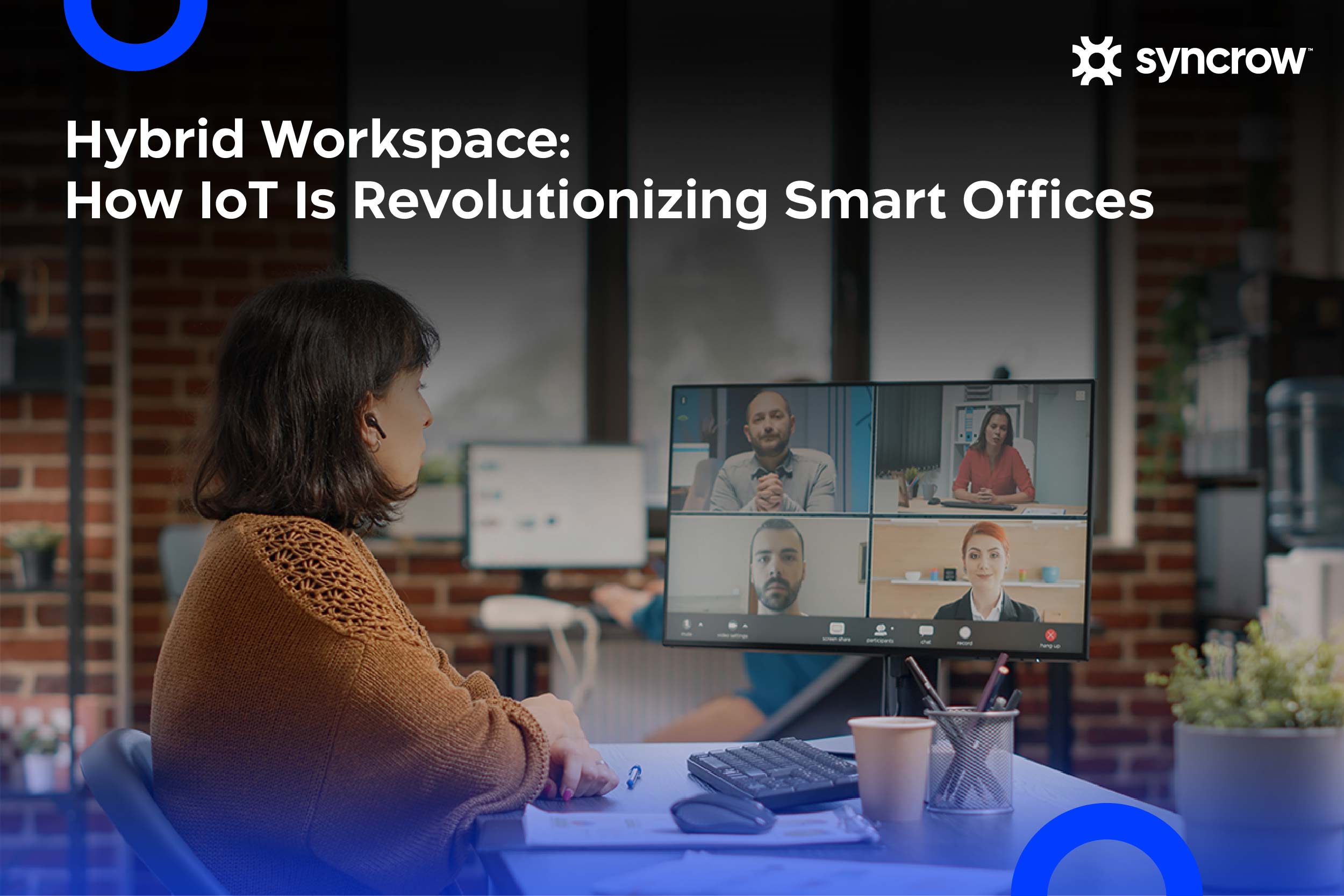
55% of UAE employees do not prefer daily on-site work, making hybrid work a cornerstone solution for modern business with flexibility, efficiency, and most importantly, cost savings. Organizations can optimize office space, reduce costs, and maintain productivity while giving employees the freedom to choose how and where they work. Hybrid work models also support better work-life balance, helping attract and retain top talent.
IoT and smart technologies are transforming hybrid workspaces into intelligent, responsive environments. These systems create seamless and comfortable experiences for employees. This combination of flexibility and technology is shaping the future of offices, making them more efficient, engaging, and adaptive.
What Is a Hybrid Workspace?
A hybrid workspace is a flexible work model that combines remote and in-office work, allowing employees to choose where they work based on schedules, tasks, or preferences. Modern hybrid workplaces are supported by IoT and smart systems that enable collaboration, communication, and productivity across teams regardless of their location.
In traditional offices, hybrid work creates challenges such as poor space visibility, inefficient resource usage, inconsistent employee experiences, and difficulty managing collaboration, scheduling, and environmental conditions across shared workspaces.
Challenges of Hybrid Workspaces
Hybrid workspaces face different challenges due to different working teams to keep the workflow and productivity in the best levels. Managing these challenges effectively will keep processes and operations efficient.
Poor Space Visibility
Organizations often struggle to understand how office spaces are used in hybrid environments. Without real-time data, desks and meeting rooms may remain underutilized or overfull, reducing overall workplace efficiency.
Collaboration Gaps
Hybrid work can create communication gaps between remote and in-office teams. Lack of visibility and coordination tools may lead to missed interactions, delayed decisions, and reduced team collaboration across distributed work environments.
Inefficient Booking
Manual or outdated booking systems often result in double bookings, unused reserved spaces, or scheduling conflicts. This creates frustration for employees and reduces the effectiveness of shared workspace management.
Inconsistent Experience
Employees may face inconsistent workplace conditions, such as varying temperatures, lighting, or room setups. This lack of standardization can impact comfort, productivity, and overall employee satisfaction across different office spaces.
IoT solutions address these challenges by providing real-time data, automation, and smart control across workspaces. It improves visibility, optimizes booking, enhances collaboration, and ensures consistent, personalized experiences in hybrid office environments.
How IoT Is Transforming Hybrid Workspaces
IoT is changing how hybrid offices operate by making them smarter, more adaptive, and data-driven. It enables better decision-making and seamless workplace experiences through real-time insights and automation.
Real-Time Data
The Internet of Things (IoT) is reshaping hybrid workspaces by turning traditional offices into responsive and data-driven environments. Smart sensors and connected devices collect real-time data on occupancy, lighting, temperature, noise levels, and air quality, allowing the workspace to adapt in real time to employees’ needs.
Automation
IoT enables automated responses across workspaces by adjusting lighting, temperature, and other environmental conditions based on real-time data. This reduces manual intervention and ensures efficient, consistent operations throughout the office.
Personalization
Even when the same area is shared by different teams, IoT ensures a personalized experience. Workstations remember individual preferences for lighting, desk height, or climate settings, creating a more comfortable and user-focused environment.
Integration
IoT integrates different office systems into a unified ecosystem, where meeting rooms automatically adjust to scheduled teams. This creates a seamless, comfortable, and productive environment for everyone, regardless of who uses the space or when.
The Benefits of IoT in Hybrid Workspaces
The concept of a hybrid workspace is becoming more popular among companies, including international ones, due to the many benefits. Employees are now more interested in hybrid work opportunities due to the flexibility and convenience they offer. The main benefits of IoT in a hybrid workplace are:
- Improved employee productivity.
- Enhanced workplace comfort and workplace wellbeing.
- Encouraging employees to return to the office.
- Operational efficiency and space optimization.
- Energy savings and cost reduction.
- Supporting sustainability goals and reporting.
Improved Employee Productivity
IoT enables real-time monitoring and automated adjustments of workspace conditions, helping employees collaborate efficiently, focus on their work, and reduce distractions, leading to higher productivity in hybrid work environments.
Enhanced Workplace Comfort
Smart sensors and devices adjust lighting, temperature, and air quality to employees’ preferences, creating a comfortable, supportive, and healthy workspace that enhances team concentration, job satisfaction, and engagement across projects.
Encouraging Employees to Return to the Office
IoT-driven hybrid offices offer flexible, data-informed spaces and personalized experiences, making the workplace more appealing and motivating for employees to choose in-office collaboration over completely remote work.
Operational Efficiency and Space Optimization
Data collected from IoT devices helps managers optimize office layouts, reduce wasted space, and streamline daily operations for more cost-effective hybrid office management while ensuring comfort.
Energy Savings and Cost Reduction
Automated lighting, HVAC, integrated sensors, and centralized platforms reduce energy waste while lowering utility costs by ensuring systems operate only when needed. This provides real financial benefits and improves the efficiency of day-to-day office operations.
Supporting Sustainability Goals and Reporting
IoT systems track energy usage and environmental metrics, enabling organizations to accelerate sustainability initiatives, make data-driven decisions, and generate accurate sustainability reports for compliance and reporting purposes.
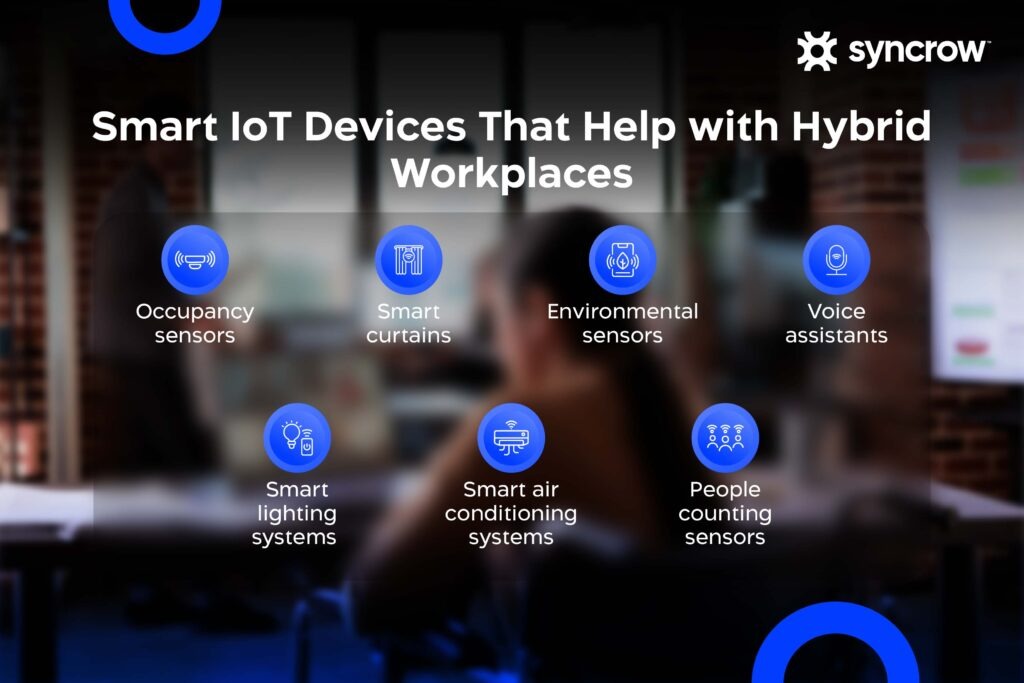
Smart IoT Devices That Help with Hybrid Workplaces
Various smart IoT devices support hybrid workplaces by making work easier for all teams. These IoT devices, when integrated into a smart office system, enhance the indoor environment, optimize utility usage, and improve comfort and productivity, and make the office space ready for multiple users without challenges. The main smart devices used in hybrid workspaces are:
- Occupancy sensors
- People counting sensors
- Environmental sensors
- Smart lighting systems
- Smart air conditioning systems
- Smart curtains
- Voice assistants
Occupancy Sensors
Occupancy sensors detect when employees enter or leave workspaces, enabling real-time monitoring, automated lighting and HVAC adjustments, and improved space utilization for efficient hybrid office management.
People Counting Sensors
People counting sensors track the number of occupants in rooms or zones in real-time, helping optimize meeting room usage, prevent overcrowding in shared spaces, and support data-driven decisions for space planning and employee safety.
Environmental Sensors
Environmental sensors monitor temperature, humidity, air quality, and lighting levels, ensuring the best comfort, supporting employee health, and enabling automated adjustments that enhance productivity and sustainability in hybrid offices.
Smart Lighting Systems
Smart lighting systems adjust brightness levels and color tones based on occupancy, daylight, preferences, or schedules, reducing energy costs, improving employee comfort, and creating dynamic work environments that adapt to hybrid office needs.
Smart Air Conditioning Systems
Smart air conditioning systems automatically adjust temperature, fan speed, and cooling zones based on occupancy and preferences, avoiding sudden temperature changes, improving comfort, reducing energy usage, and supporting sustainability across hybrid workspaces. This helps employees stay focused and comfortable during working hours.
Smart Curtains
Smart curtains can open or close automatically based on time, sunlight, or room usage, enhancing comfort, controlling natural light, saving energy, and creating an adaptable, employee-friendly environment in hybrid offices.
Voice Assistants
Voice assistants enable hands-free control of lights, HVAC, curtains, and meeting systems in each room independently. Voice assistants in workspaces simplify space management, improve accessibility, and support a smart hybrid office experience.
Smart Hybrid Workspaces Vs Traditional Hybrid Workspaces
Smart hybrid workspaces use IoT and automation to optimize office performance and improve team satisfaction and comfort, while traditional hybrid setups rely on manual processes. The difference lies in efficiency, data visibility, employee experience, and the ability to adapt to changing workplace demands.
| Feature | Traditional Hybrid Workspace | Smart Hybrid Workspace |
| Occupancy & Space Management | Manual booking | Smart occupancy tracking |
| Environmental Control & Sustainability | Static settings | Automated adjustments |
| Productivity | Rely on environments and basic tools | Enhanced through adaptive workplace conditions |
| Seamless Collaboration | Basic tools | Integrated smart systems |
| Personalized Workstations | Limited | User-based preferences |
| Safety and Security | Reactive | Real-time monitoring |
How Smart Booking Systems Support Hybrid Workspaces?
A smart booking system is an IoT-enabled platform that allows employees to reserve desks, meeting rooms, and shared spaces efficiently through apps or integrated workplace software.
IoT platforms, like the SyncOS platform, can provide real-time availability, utilization data, and automated scheduling to enable effective booking systems for all teams, avoid scheduling conflicts, improve collaboration, and enhance the overall hybrid workplace experience.
- Reduce unused space by tracking real-time occupancy and improving space utilization.
- Optimize real estate costs by aligning office size and resources with actual usage.
- Improve employee retention by offering flexible, reliable, and convenient workspace experiences.
- Increase operational efficiency through automated scheduling and reduced administrative workload.
- Enhance decision-making with data-driven insights on space usage and employee behavior.
Conclusion
Hybrid work is here to stay, and IoT is making it smarter, more efficient, and more engaging for employers and employees. Connected and integrated devices, sensors, and automated systems create flexible and personalized environments that boost productivity, comfort, and sustainability.
Syncrow is a smart office solutions provider in Dubai that provides an IoT platform and solutions to enable seamless control of lighting, climate, security, occupancy, and collaboration tools. With Syncrow, businesses can transform traditional workspaces into adaptive, data-driven hybrid environments customized for their team. Learn more with our free consultation session.
FAQs About Hybrid Workspaces
What is Hybrid IoT?
Hybrid IoT combines cloud-based and IoT systems, allowing businesses to manage devices, collect data, and automate processes both locally and remotely for smarter, more efficient operations.
What Is a Hybrid Workplace?
A hybrid workspace blends remote and in-office work, offering flexible schedules, adaptable office environments, and smart technologies to support productivity, collaboration, and employee wellbeing.
What are the 5 C’s of Hybrid Work?
The 5 C’s of hybrid work are: Collaboration, Communication, Culture, Connectivity, and Compliance. These help organizations create and maintain flexible, productive, and secure hybrid working environments.
What Is a Smart Workspace?
A smart workspace uses a smart solution with integrated IoT devices, sensors, and automation to optimize office conditions, improve collaboration, enhance comfort, save energy, and enable data-driven decision-making for employees and managers.
What Is a Smart Office System?
Smart office systems integrate connected devices and software to manage lighting, climate, security, occupancy, and collaboration tools, enhancing efficiency, comfort, productivity, and sustainability in modern hybrid workplaces.