Electricity bills can rise quickly in UAE homes, especially during summer, yet the total does not show which systems or habits caused the increase. Understanding what uses the most electricity at home is the first step toward managing energy more effectively.
High home electricity consumption is rarely caused by one appliance alone. Cooling, water heating, refrigeration, cooking, laundry, lighting, and connected electronics all contribute. Comparing both power draw and operating time makes it easier to identify which systems have the greatest impact on total home energy consumption.
This guide explains what uses the most electricity at home in the UAE, why summer demand rises, what affects monthly kWh, and how common household appliances compare. It also shows how to estimate appliance use and cost in AED using DEWA rates, how smart home controls can support better energy management, and how to reduce unnecessary energy consumption without compromising comfort.
What Uses the Most Electricity in a UAE Home?
In most UAE homes, air conditioning is usually the largest electricity user because it combines high power demand with long operating hours. Other major loads include water heating, refrigeration, laundry, cooking, lighting, and electronics that use standby power.
Main Electricity-Using Systems and Appliances in UAE Homes
| Appliance/System | Why It Uses the Most Electricity | What Affects Electricity Use |
| Air conditioning | Cool the home | Thermostat setting, home size, insulation, outdoor temperature, operating hours |
| Water heater | Heating water | Tank size, hot-water demand, temperature setting, schedule |
| Refrigerator & freezer | Maintain food | Appliance size, efficiency, room temperature, door openings |
| Washing machine & dryer | Heating water and drying clothes | Wash temperature, drying cycle, load size, frequency |
| Oven & electric cooking appliances | Generate heat for cooking | Cooking temperature, preheating, cooking time, frequency |
| Household lighting | Multiple lights can add up over time. | Bulb type, wattage, number of lights, operating hours |
| Standby power & always-on devices | Continuous electricity consumption | Number of devices, standby time, network activity |
Air Conditioning
In most UAE homes, air conditioning ranks first when assessing what uses the most electricity at home. DEWA reports that cooling accounts for about 60% of Dubai’s peak-load electricity use, but this figure does not represent every household’s monthly consumption or bill.
Water Heater
An electric water heater does not use its rated power continuously. The heating element switches on only when needed, so monthly consumption depends on how often and how long it operates, as well as heat loss from the tank.
Refrigerators, Dryers, Ovens, and Other Appliances
After cooling, what appliance uses the most electricity varies by home. A refrigerator, dryer, or oven may have the greatest non-cooling impact depending on its efficiency, capacity, operating time, and household use.
Standby Power and Phantom Load
Standby power is electricity used when a device is switched off or not performing its main function but still connected to power supply. A router operating normally is an always-on load rather than standby use, while phantom load commonly refers to electricity consumed by inactive devices.
Why Does Home Electricity Consumption Increase During UAE Summers?
During UAE summers, home electricity consumption usually rises because hotter outdoor temperatures increase the amount of cooling needed to keep indoor spaces comfortable. Main reasons are:
- Extreme outdoor heat: Summer temperatures often exceed 40°C, forcing cooling systems to work harder to maintain comfortable indoor conditions.
- Longer air conditioning operation: Air conditioning may run for 24 hours in UAE summer, in some homes, to maintain a consistent indoor temperature.
- Greater cooling demand in larger villas: Many UAE villas have multiple floors, large living spaces, and expansive windows, requiring more energy to cool than smaller apartments.
- Higher occupancy during the hottest hours: Families often spend more time indoors during the afternoon and evening, increasing the use of energy.
- Increased hot water demand: More frequent showers after outdoor activities can increase water heater use, especially in larger households.
How Much Electricity Does a UAE Home Use and What Affects It?
There is no single average kWh per month for UAE homes or fixed answer to what uses the most electricity at home. Property type, cooling arrangement, household size, season, and daily routines all affect total consumption. Key factors include:
- Home type and size: Larger villas usually include more cooled space, lighting, water heaters, pumps, and appliances than apartments.
- Cooling and billing arrangement: Different cooling systems create different consumption and billing patterns, while district cooling may be billed separately.
- Household size: More residents usually increase hot-water use, laundry, cooking, lighting, and electronics use.
- Seasonal usage: Hotter months usually increase cooling demand, so year-over-year comparisons provide a clearer view of changing consumption.
- Daily routines: Cooking, laundry, appliance schedules, and time spent at home influence average home electricity usage.
- Control settings: Timers, schedules, and occupancy settings determine how long cooling, lighting, and water heating remain active.
Household Appliance Comparisons: Which Uses More Electricity in the UAE?
To understand what uses the most electricity at home, compare appliance power consumption with operating time, capacity, and efficiency. A high-powered appliance used briefly may consume less electricity than a lower-powered appliance used for several hours.
| Appliance Comparison | Which Usually Uses More Electricity? |
| Fan or AC | AC. It removes heat, while a fan only circulates air. |
| Geyser or AC | Usually AC over a full day. A geyser uses high power only while heating water. |
| Oven or air fryer | Usually the oven for small portions. Several air-fryer batches can narrow the difference. |
| Kettle or microwave | It depends on the task. Use a kettle for boiling water and a microwave for reheating food. |
| LED vs. bulbs | LED bulbs. They use less electricity than incandescent bulbs for similar light output. |
| Washer or dryer | Usually the dryer. Heating and removing moisture require more electricity. |
| Central air or window AC / Portable vs. window AC | It depends. Capacity, efficiency, room size, installation, and operating time determine consumption. |
| Fridge or freezer | It depends on the model. Compare capacity, efficiency, temperature settings, and annual kWh. |
| TV or lights | It depends on total wattage and operating time. Several lights may use more than one television. |
| Electronics using standby power | Low per device but cumulative. Total use rises with more devices and longer standby periods. |
How to Estimate Appliance Electricity Cost in the UAE
To estimate what uses the most electricity at home, calculate an appliance’s monthly kWh from its rated power and operating time, then apply the relevant electricity rate. Actual consumption may vary when an appliance cycles or changes power during operation.
Calculation Formulas
- Calculate Monthly Electricity Use
Monthly use (kWh) = Power (W) ÷ 1,000 × Daily operating hours × Days
- Estimate the Appliance Cost
Estimated cost (AED) = Monthly kWh × Applicable electricity rate
Note: kW measures how much electrical power an appliance uses while operating, while kWh measures how much energy it consumes over time.
DEWA Electricity Rates
The electricity cost in UAE homes varies by emirate and utility provider. For homes in Dubai supplied by DEWA, the cost depends on the monthly consumption slab, electricity fuel surcharge, 5% VAT, and whether the additional use crosses a slab threshold:
| Monthly DEWA Consumption | Base Electricity Tariff | Combined Rate Before VAT | Combined Rate Including 5% VAT |
| 0–2,000 kWh | AED 0.23/kWh | 0.23 + 0.06 = AED 0.29/kWh | AED 0.3045/kWh |
| 2,001–4,000 kWh | AED 0.28/kWh | 0.28 + 0.06 = AED 0.34/kWh | AED 0.3570/kWh |
| 4,001–6,000 kWh | AED 0.32/kWh | 0.32 + 0.06 = AED 0.38/kWh | AED 0.3990/kWh |
| Above 6,000 kWh | AED 0.38/kWh | 0.38 + 0.06 = AED 0.44/kWh | AED 0.4620/kWh |
Note: The VAT-inclusive rates are calculated by multiplying the combined rate by 1.05. These figures cover home energy consumption only and do not represent the complete DEWA bill.
How Smart Home Technology Helps Reduce Home Electricity Consumption in the UAE
Smart home technology helps UAE homeowners reduce unnecessary electricity use by monitoring consumption and controlling high-use systems through schedules, occupancy-based settings, and coordinated routines. This makes what uses the most electricity at home easier to manage without constant manual adjustments. Key smart home solutions for reducing energy use include:
- Smart AC control
- Smart energy monitoring
- Automated control
Smart AC Control
Smart AC control uses schedules, room settings, and occupancy to adjust air conditioning according to how each space is used. In compatible systems, it can reduce cooling in empty rooms while maintaining comfort in occupied ones.
Smart Energy Monitoring
Smart energy monitoring helps UAE homeowners compare daily, weekly, and monthly home electricity usage. It does not reduce consumption directly, but energy monitoring tools can reveal unusual increases and indicate when further investigation is needed.
Automated Control
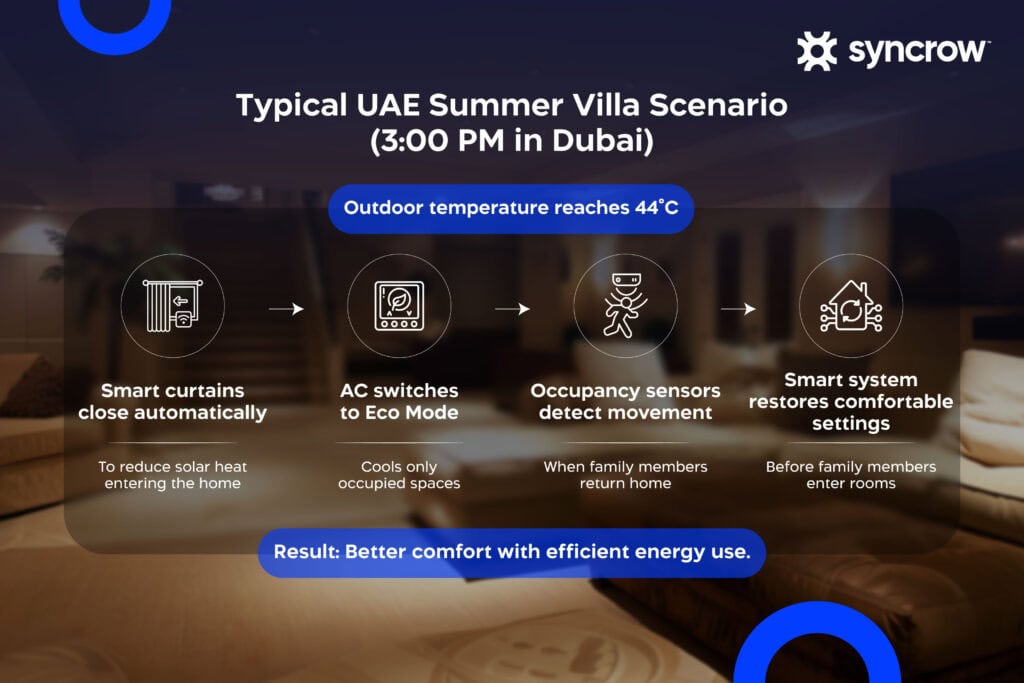
Automated control coordinates climate control, lighting, smart curtains, and water heater control through smart scenes for leaving, returning, or sleeping. A smart energy management system can apply these settings together, helping prevent systems from operating longer than necessary.
Practical Ways to Reduce Home Electricity Consumption in the UAE
UAE homeowners can lower household electricity consumption by reducing unnecessary operating time and choosing settings that match daily routines. Upgrading to smart home solutions in UAE can help prevent systems and appliances from using more electricity than necessary. Main steps include:
- Reduce solar heat: Close curtains or blinds during strong sunlight and keep doors and windows closed while the AC runs.
- Limit water heating: Schedule the electric water heater around regular hot-water use instead of leaving it on all day.
- Use lighting efficiently: Choose LED bulbs and switch off lights in unoccupied rooms.
- Manage air conditioning: Keep the smart thermostat at a comfortable, consistent setting and avoid cooling empty rooms.
- Run laundry efficiently: Wash full loads, use lower-temperature cycles where suitable, and avoid over-drying.
- Match the cooking appliance to the task: Choose an appliance that suits the portion size and required cooking time.
- Reduce standby power: Switch off or unplug devices that do not need to remain powered.
- Compare appliance efficiency: Review annual kWh where listed, capacity, and the star rating on the UAE efficiency label before buying energy-efficient appliances.
Final Thoughts
Understanding what uses the most electricity at home helps UAE homeowners see where most electricity is going and focus on the changes that can make the greatest difference to monthly consumption.
Manage Your Home Energy Consumption More Efficiently
During UAE summers, the greatest energy savings come from an integrated system where climate control, occupancy sensors, smart curtains, lighting, and water heater control work together. Curtains can reduce heat gain before peak afternoon temperatures, sensors can adjust cooling in unoccupied areas, and smart thermostats can maintain comfortable temperatures more efficiently. Syncrow connects these solutions through one system, helping UAE homeowners create a smarter, more responsive home that reduces unnecessary energy use while maintaining everyday comfort. Reach out and book a home energy consumption free consultation.
FAQs About What Uses the Most Electricity at Home in the UAE
Can Smart Home Technology Help Reduce Electricity Bills in UAE Homes?
Yes. Smart home technology can lower electricity bills by scheduling cooling and water heating, using occupancy-based control, and flagging unusual consumption. Results depend on compatible equipment, suitable settings, household routines, and consistent use.
Does AC Use the Most Electricity?
Yes. In most UAE homes, air conditioning is the largest electricity load because it operates for long periods. AC power consumption vary by efficiency, thermostat settings, insulation, outdoor temperature, and cooled area.
Does a Fan Use Less Electricity Than AC?
Yes. A fan uses far less electricity because it circulates air instead of removing heat. It can improve comfort in an occupied room, but it does not lower the indoor temperature or replace air conditioning.
Does Standby Mode or Leaving Things Plugged In Use Electricity?
Yes. Some devices use standby power while switched off or idle, creating a phantom load. Televisions, consoles, and set-top boxes are common examples, although active appliances and cooling usually consume more electricity overnight.
How Much Electricity Does the Average Dubai Home Use?
There is no reliable figure for every Dubai home. Average kWh per month varies by property size, cooling system, occupancy, season, appliances, and routines. Comparing the same month year over year gives a clearer view of changing consumption.
What Uses the Most Electricity in an Apartment or Flat?
Cooling is often the largest in-home load when assessing what uses the most electricity in an apartment or what uses the most electricity in a flat. If district cooling is billed separately, another appliance may lead the electricity bill.
What Kitchen Appliance Uses the Most Electricity?
A full-size electric oven often uses the most electricity in the kitchen because it combines high power with longer cooking times. For small portions, an air fryer or microwave usually uses less by heating food faster.