UAE homes rely heavily on air conditioning during summer, but many existing units are still operated through a handheld remote or fixed wall controller. That makes forgotten or unnecessary cooling harder to correct when the home is empty.
A compatible smart air conditioner retrofit can add app control, schedules, voice commands, or automation without a full AC replacement. The best retrofit option depends on the unit’s existing controls, supported functions, and overall condition.
This guide explains what a smart air conditioner is, why it matters during UAE summers, how to make your AC smart through retrofit, and when replacement is more suitable. It also covers connected operation, differences between smart AC, normal AC, and inverter AC, available features, controller selection and compatibility, costs, electricity savings, and DEWA or district-cooling charges.
What Is a Smart Air Conditioner?
A smart air conditioner is an AC that supports connected control through built-in connectivity or a compatible external controller. Depending on the system, it may provide app access, schedules, voice commands, automation, and operating information as part of wider smart climate control.
Why Smart AC Control Matters During UAE Summers
Connected cooling becomes especially useful during UAE summers because higher outdoor temperatures can increase cooling demand and operating hours. Smart AC control helps households manage comfort around changing schedules and occupancy without relying entirely on a handheld remote or fixed wall controller. Key benefits include:
- Manage longer cooling periods: Connected control makes it easier to adjust AC operation when hotter weather requires more cooling.
- Adjust cooling remotely: Remote access enables residents to adjust supported settings from another room or while away from home.
- Match cooling to changing routines: Flexible scheduling keeps AC operation aligned with work hours, sleep schedules, weekends, and travel plans.
- Align comfort with room use: Compatible schedules and automations can cool rooms before people arrive and reduce operation when they are empty.
Smart AC Retrofit vs. AC System Replacement: Which Is Better?
Upgrading your existing AC to a smart air conditioner is generally the better choice when it cools effectively, remains reliable, and supports a compatible controller. Replacement is suitable when poor cooling, recurring faults, low efficiency, incorrect sizing, or limited compatibility make it impractical to keep. Start by determining which option is more appropriate for your system:
- When to Retrofit Your Existing AC
- When to Replace Your AC System
When to Retrofit Your Existing AC
A retrofit is appropriate when the AC cools effectively, remains reliable, and supports a compatible smart AC controller. A remote-controlled split AC may use an IR controller, while a compatible wired central AC system may use a smart thermostat or control panel.
When to Replace Your AC System
Replacement is appropriate when the AC cools poorly, breaks down repeatedly, is incorrectly sized, or needs substantial repairs. Poor energy performance or an inability to support the required connected functions may also make replacement the better long-term choice.
How Does a Smart Air Conditioner Work?
A smart air conditioner receives instruction from an app, voice assistant, schedule, or automation. Built-in connectivity or a compatible smart AC controller sends the command to the AC, which applies the requested setting and returns status information when two-way communication is supported.
| Step | What Happens | Practical Result |
| Request | An app, voice assistant, schedule, or automation initiates a supported adjustment. | Cooling can be adjusted remotely or automatically. |
| Command | Built-in connectivity or a compatible controller sends an instruction the AC recognizes. | The selected setting reaches the AC without using the original control. |
| Response | The AC applies the instruction, and the platform displays available feedback. | Two-way control may confirm the status; one-way infrared control may show only the latest command. |
What Is the Difference Between Smart AC, Normal AC, and Inverter AC?
A smart air conditioner provides connected control, while an inverter AC varies compressor output according to cooling demand. A normal AC typically uses a fixed-speed compressor and standard controls. An AC can therefore include both smart control and inverter technology.
| AC Type | Defining Feature | Practical Difference |
| Smart AC | Provides connected control and may use a fixed-speed or inverter compressor. | Can simplify cooling management, but electricity use still depends on AC efficiency, settings, and operating time. |
| Normal AC | Uses a fixed-speed compressor that cycles between full output and off. | Can produce greater temperature variation and use more electricity than a comparable inverter model. |
| Inverter AC | Varies compressor output according to cooling demand. | Can maintain steadier temperatures and use less electricity than a comparable fixed-speed model. |
What Can Smart AC Control Do?
Smart AC control enables app access, voice commands, cooling schedules, automated adjustments, and operating data through a compatible smart air conditioner or controller. Available functions depend on the AC model, platform, sensors, permissions, and whether the connection supports one-way commands or two-way status feedback. Smart AC can:
- Control your AC through an app or voice assistant
- Schedule cooling and adjust temperature settings
- Automate cooling with geofencing, occupancy, and smart home scenes
- View AC status and available operating data
Control Your AC through an App or Voice Assistant
App control is useful for immediate adjustments, while a linked voice assistant provides hands-free control at home. Depending on compatibility, both can switch the smart AC on or off and change its mode, temperature, or fan speed.
Schedule Cooling and Adjust Temperature Settings
Schedules work best for predictable routines, such as waking, sleeping, leaving for work, or returning home. A smart AC controller can adjust cooling at selected times, reducing the need to repeat the same changes everyday.
Automate Cooling with Geofencing, Occupancy, and Smart Home Scenes
Geofencing can respond to a phone’s location, sensor-based automation can respond to room occupancy, and smart home scenes can coordinate cooling with broader household routines when the required sensors, permissions, and connections are available.
View AC Status and Available Operating Data
Status and operating data help clarify what the connected system is doing. Depending on the system, a smart air conditioner app may show temperatures, operating status, alerts, runtime, or energy information. Estimates and runtime should not be mistaken for measured kilowatt-hours.
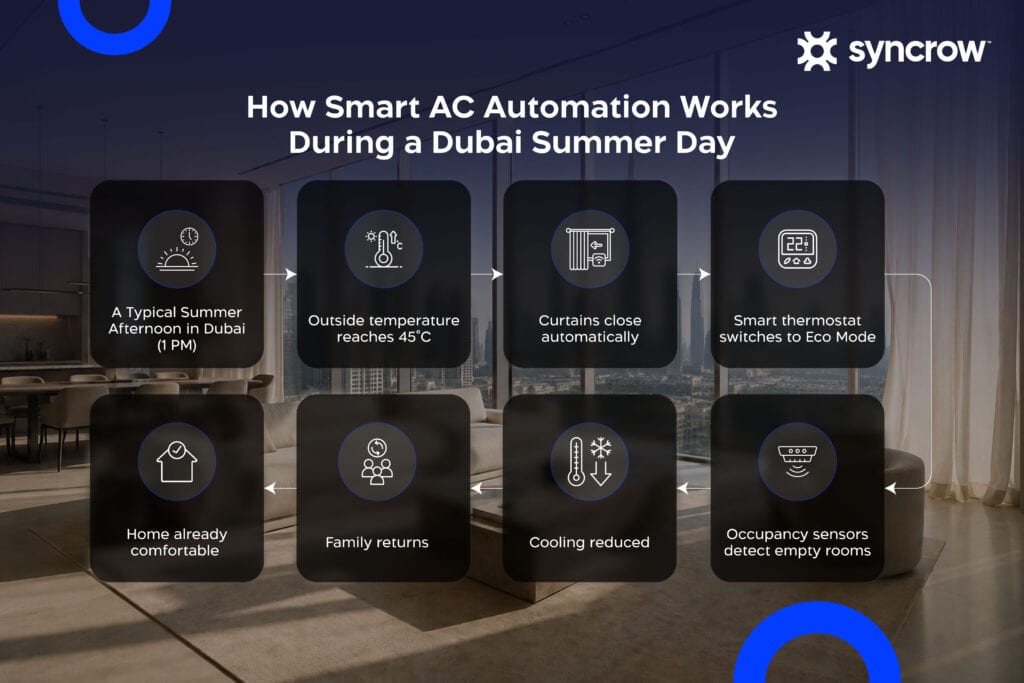
How Smart AC Automation Works During a Dubai Summer Day
During a Dubai summer day, a connected smart home can coordinate cooling, motorized curtains, occupancy sensors, and arrival scenes as outdoor temperatures and room use change. The sequence shows how automation can limit unnecessary cooling while restoring comfortable settings before residents return.
Smart AC Works Best as Part of a Connected Smart Home
Smart AC control delivers greater value when integrated with occupancy sensors, motorized curtains, smart lighting, and home automation scenes. Together, these systems allow cooling, shading, and lighting to respond to shared sensor inputs and household routines.
Luxury UAE homeowners expect a comfortable home before they arrive. Pre-arrival cooling can restore preferred temperature settings before residents return, while automation limits unnecessary operation in unused areas throughout the day. The result is steadier comfort, fewer manual adjustments, and more efficient everyday cooling.
How to Choose a Smart AC Controller for UAE Homes
The right smart AC controller must work with the existing AC and meet the household’s needs. UAE homeowners should confirm compatibility, controller coverage, installation requirements, connectivity, data reporting, warranty terms, and available support. UAE homeowners must:
- Confirm compatibility: Avoid an incompatible purchase by checking the AC and remote model numbers, control method, built-in connectivity, condition, and maintenance status. Wired, proprietary, or building-managed systems should be assessed by a qualified professional.
- Calculate coverage and total cost: Determine the full installed cost by counting the indoor units or zones and required controllers. Include placement requirements, a reliable infrared signal path where applicable, and installation charges.
- Prioritize useful functions and data: Define what the smart air conditioner should do each day, then separate essential controls from optional extras. Confirm whether the app verifies AC status and reports measured electricity use, estimates, or runtime only.
- Check connectivity and original controls: Maintain reliable app control by checking the supported Wi-Fi band, signal strength, app availability in the UAE, and whether remote access requires an internet connection. Confirm that the original controls remain usable during an internet or platform outage.
- Plan installation and support: Avoid installation delays by confirming placement, wiring, permanent alterations, and required approvals. Renters considering smart devices for Dubai apartments should check lease and building rules, while all buyers should verify warranty coverage and local after-sales support.
Does a Smart Air Conditioner Save Electricity and Lower DEWA Bills?
A smart air conditioner can save electricity, but only when connected control reduces kilowatt-hours compared with previous AC use. The result depends on the original operating pattern, temperature settings, occupancy, weather, AC condition, and system efficiency.
Any DEWA saving is calculated from the kilowatt-hours avoided, applicable slab tariff, fuel surcharge, and VAT. District cooling is billed differently: reduced cooling use may decrease the consumption charge, while capacity and other fixed charges can remain unchanged.
Final Thoughts
Choosing the right smart air conditioner retrofit helps UAE homeowners improve everyday cooling control without replacing an AC that still performs well.
Upgrade Your Existing AC with Smart Control
Depending on compatibility, Syncrow can integrate a universal IR module, smart air condition thermostat, or smart control panel with the existing cooling setup. Syncrow’s wireless-first Smart AC solutions connect cooling with lighting, occupancy sensors, motorized curtains, and home automation scenes through one system. Supported app control, schedules, and voice commands provide direct access when needed, while automation manages routine adjustments. This approach can reduce the need for extensive rewiring and create one coordinated climate control experience across the home. Reach out and book a smart AC control consultation.
FAQs About Smart Air Conditioner in the UAE
Can Every Air Conditioner Be Made Smart?
No. An external controller can turn an existing AC into a smart air conditioner only when it supports the AC’s control method and commands. Proprietary, wired, or building-managed systems may need a professional compatibility assessment.
Does a Smart AC Controller Work with an Inverter AC?
Yes, when the controller supports the inverter AC’s interface and commands. Inverter technology regulates compressor output, while the smart AC controller provides connected control. Compatibility depends on the control system, not the compressor type alone.
Can Renters Install a Smart AC Controller?
Yes, renters can often install a compatible smart AC controller when it requires no permanent alterations. Wired installation, fixed mounting, or electrical work may require landlord and building approval, while a non-invasive IR controller may avoid those changes.
Will a Smart Air Conditioner Work without Wi-Fi or an Internet Connection?
A smart air conditioner may retain manual control without Wi-Fi or internet, but connected functions can be limited. Remote access, voice services, cloud-based automations, and updates may stop, while locally stored schedules depend on the controller and platform.
Does a Smart AC Controller Measure Electricity Use?
Not always. A smart AC controller measures electricity use only if it includes or receives data from compatible metering hardware. Runtime, command history, and calculated estimates are not measured kilowatt-hours and should not be treated as equivalent figures.
Can Smart AC Control Be Used with District Cooling?
Yes, when the smart AC thermostat or controller is compatible with the property’s in-home fan-coil control arrangement. Smart AC control can adjust the home’s cooling settings, but it does not control the district-cooling plant or change the provider’s tariff structure.
How Much Does a Smart AC Controller Cost in the UAE?
No standard price applies across the UAE. The cost of a smart AC controller depends on the control method, number of units or zones, required hardware, installation, warranty, and support. Homeowners should compare full installed quotations rather than device-only prices.