


Smart building sensors are increasingly becoming a cornerstone of modern buildings and facilities, especially as rising operational costs push property owners to optimize energy use and reduce waste. These IoT sensors monitor environmental conditions, occupancy, energy use, and safety indicators, supporting the shift toward more data-driven buildings. As part of the UAE’s broader smart city initiatives, they play a key role in making buildings more intelligent and responsive to occupants’ needs.
Beyond simple monitoring, smart building sensors empower integrated smart systems by sharing real-time data with centralized platforms. This connectivity enables the automated control of lighting, HVAC, security, and energy management systems, allowing businesses to enhance operations, reduce costs, and make data-driven decisions that improve comfort, safety, and total building performance.
What Are Smart Building Sensors?
Smart building sensors are connected devices that monitor physical conditions such as temperature, occupancy, light, energy use, and air quality. They collect data continuously and enable buildings to automatically adjust systems, improving efficiency, safety, comfort, and overall operational performance across residential and commercial environments.
These smart sensors act as the foundation of an IoT smart building solution, connecting to centralized platforms to share data, trigger automation, and integrate seamlessly with systems like lighting, HVAC, security, curtains, and energy management.
How Sensor Technology Powers Smart Buildings?
Sensor technology powers smart buildings by continuously collecting live data on environmental conditions, occupancy, energy usage, and system performance. This data enables automated responses such as adjusting lighting, optimizing HVAC operations, and improving space utilization, helping buildings operate more efficiently while enhancing comfort, wellness, and safety.
The sensors rely on communication protocols like Zigbee, Wi-Fi, or Bluetooth to transmit data to centralized platforms. Proper integration and compatibility are essential to ensure accurate insights, system stability, reliable automation, and scalability.
Types of Smart Building Sensors
There are different types of sensors used in smart buildings based on location, space utility, and requirements. Integrating the right smart building sensors is essential to get the needed data and manage the building accordingly.
Smart Occupancy and Motion Sensors
Smart occupancy and motion sensors detect the presence and movement of people within a space, enabling automated activation and control of lighting, curtains, HVAC, and security systems. In commercial environments, they help reduce energy waste, enhance safety control, improve space utilization, and support informed decisions for facility and workforce management as well.
Temperature and Humidity Sensors
These smart building sensors monitor indoor climate conditions in real time, maintaining optimal comfort and system performance for all building users. Having efficient HVAC control, protecting sensitive equipment, and maintaining required environmental standards in offices, healthcare centers, and operational spaces supports a stable, growing, and successful business.
Air Quality Sensors
Air quality sensors track key parameters such as CO2 levels, particulate matter, and pollutants to maintain healthy indoor environments, improve employee wellbeing, meet regulatory standards, and optimize ventilation systems. Good air quality ensures safe conditions across buildings and increases the productivity and wellness of working teams.
Energy Sensors
Based on the installation strategy, the energy sensors measure electricity consumption across systems, equipment, or entire facilities. These sensors provide clear visibility into usage patterns and help businesses identify inefficiencies and support sustainability goals through smarter energy management. Energy sensors also help facilities reduce energy bills and operational costs.
Smart Light Sensors
Smart light sensors detect light levels and automatically adjust indoor lighting to ensure better visibility for everyone. They enhance energy efficiency by reducing unnecessary usage in empty rooms, improve occupants’ comfort, and support adaptive lighting strategies that align with natural daylight, creating more productive and sustainable work environments.
Water Leak Sensors
Water leak sensors detect the presence of unwanted moisture or leaks in critical areas such as pipelines, ceilings, or equipment rooms. In commercial buildings, they help prevent costly damage, reduce downtime, and enable immediate alerts and fast responses to protect assets and maintain operational continuity.
Gas Leak Sensors
Monitoring the presence of hazardous gases provides early detection and alerts in case of leaks. This is vital to ensure safety compliance, protect occupants, enable timely response, and prevent accidents, damage, or operational disruptions.
Vibration and Shock Sensors
Vibration and shock sensors detect unusual movements, impacts, or structural changes in equipment and infrastructure. Businesses use them for predictive maintenance, monitoring machinery health, and securing sensitive assets, helping reduce unexpected failures, extend equipment lifespan, and improve operational reliability.
Smoke Sensors
Smoke sensors detect the presence of smoke particles in the air, providing early warning of potential fire incidents. This safety sensor is critical in commercial and industrial settings to ensure safety compliance, enable rapid evacuation, activate emergency systems, and minimize risks to people, property, and entire business operations.
Key Benefits of Smart Building Sensors
These sensors enable various features and functions in facilities through collected data and signals. Integrated sensors enhance the management efficiency and allow better decision-making.
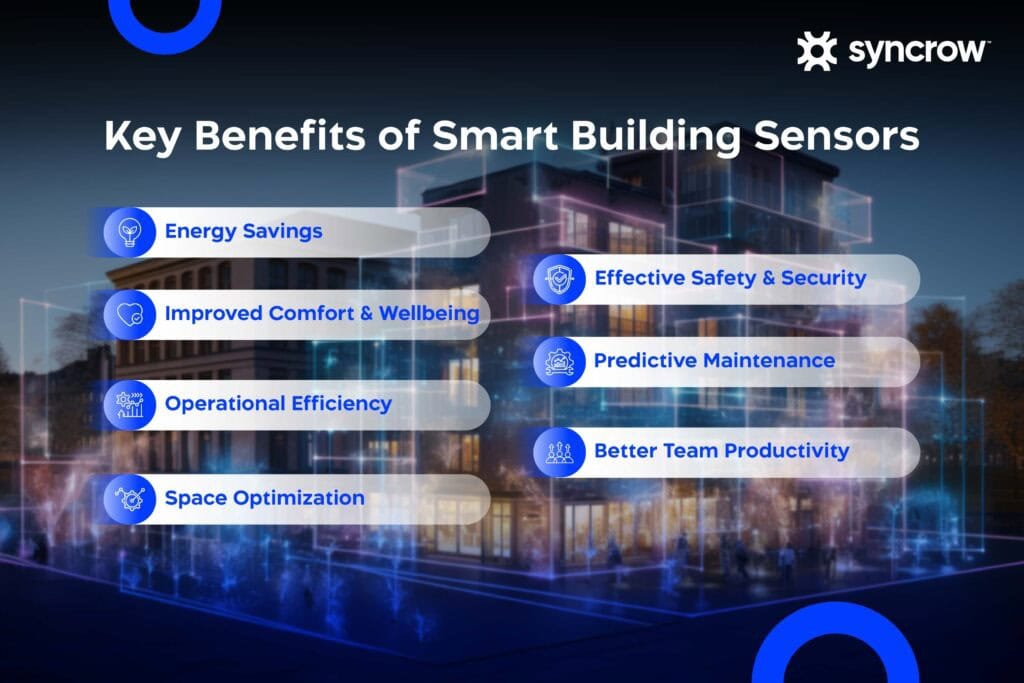
Energy Savings
Smart building sensors reduce energy consumption by automating lighting, HVAC, and equipment usage based on real-time requirements and conditions. This helps businesses lower operational costs while maintaining productivity levels and improving overall energy efficiency.
Improved Comfort and Wellbeing
Smart wellness sensors continuously monitor environmental conditions such as temperature, humidity, and air quality, ensuring ideal comfort. This supports employee wellbeing, minimizes complaints, and creates healthier, more productive indoor environments.
Operational Efficiency
By automating routine building functions and providing real-time data insights, sensors can effectively enhance facility management. This reduces the need for manual intervention, minimizes errors, and enables more efficient day-to-day operations across commercial environments.
Effective Safety and Security
Building safety is a priority for everyone, and smart sensors can enhance it by detecting motion, smoke, gas leaks, or unauthorized access immediately. When integrated with building smart systems, they enable real-time alerts and automated responses, helping organizations protect people, assets, data, and critical infrastructure.
Predictive Maintenance
Smart sensors are key technology in predictive maintenance. They monitor equipment performance and detect irregularities early, allowing businesses to identify issues before failures occur. This reduces downtime, lowers maintenance costs, and extends the lifespan of critical building systems.
Better Team Productivity
By maintaining the perfect working conditions and minimizing disruptions, smart sensors contribute to an improved work environment and employee focus and productivity. Automated environments allow teams to operate more efficiently without the need to make manual adjustments or interruptions.
Space Optimization
Occupancy sensors provide insights into how spaces are actually being used daily, helping businesses optimize layouts and resource allocation. This supports better planning, reduces unused areas, and improves workplace efficiency.
Smart Building Sensor Benefits at a Glance
- Reduce energy consumption and lower operational costs
- Enhance occupant comfort and indoor environmental quality
- Improve day-to-day operational efficiency
- Strengthen safety and security across facilities
- Enable predictive maintenance and reduce downtime
- Boost employee productivity and workplace performance
- Optimize space utilization based on real usage data
Essential Applications of Smart Building Sensors Across Industries
There is a wide range of smart sensor applications in modern buildings and facilities. These applications take place in residential, commercial, industrial, and service buildings.
Malls and Commercial Buildings
Monitoring with smart building sensors includes foot traffic, optimizing lighting and HVAC usage, and enhancing security. Businesses use this data to improve customer experience, reduce energy costs, and manage operations efficiently.
Hospitals and Healthcare Centers
Smart building sensors support patient safety by monitoring air quality, temperature, and movement. They also enable silent alerts, system triggering, and compliance with the UAE healthcare standards while improving operational efficiency and response times.
Office Buildings and Co-working Spaces
In smart offices, sensors optimize workspace usage, automate lighting and climate control, personalize spaces, and improve employee comfort. They also provide data that helps organizations enhance productivity and manage hybrid environments effectively.
Residential Buildings
Smart sensors enhance building management by monitoring energy usage, indoor environment, leaks, and security. Property managers benefit from reduced maintenance costs, while occupants experience better comfort and safety.
Hotels
Hotels use smart sensors to automate the guest journey from arrival to check-out. Customized room environments enable more manageable and enhanced guest experiences based on their preferences while reducing unnecessary energy usage.
Schools and Universities
Sensors help maintain safe and comfortable learning environments by monitoring air quality, occupancy, and temperature. Educational institutions use this data to adjust space usage, reduce energy costs, and ensure student and staff wellbeing.
How Data Analytics Can Help with These Sensors?
The data analytics process transforms raw sensor data into actionable insights by identifying patterns, trends, and irregularities across building operations. By analyzing data from occupancy, security, energy, and environmental sensors, businesses can make informed decisions, improve performance, reduce waste, and increase efficiency.
In smart building automation systems, data analytics enable better automation, predictive control, and real-time monitoring, ensuring all connected sensors and devices work together to deliver intelligent and responsive environments.
Do Smart Building Sensors Work Alone or Within an IoT System?
Smart building sensors can work alone, but they rarely operate effectively on their own, as they are most valuable when integrated within an IoT system. Connected to centralized platforms, they provide continuous data, enable automation, trigger actions, and support analytics. Sensors are the foundation of smart IoT systems, enabling better energy efficiency, safety, operational insights, and predictive building management.
Conclusion
Smart building sensors are transforming modern building management by enabling real-time monitoring, automation, and predictive insights. They improve energy efficiency, safety, comfort, and operational performance, offering businesses actionable data to manage their spaces more efficiently.
Syncrow, a smart IoT automation solutions company in Dubai, provides end-to-end smart building solutions, integrating advanced IoT sensors with centralized platforms to deliver seamless automation, enhanced energy management, and data-driven insights. Discover how to optimize operations and improve occupant experience by booking a free consultation.
FAQs About Smart Building Sensors
What Are the Examples of Smart Sensors?
Examples include occupancy and motion sensors, temperature and humidity sensors, air quality monitors, energy and light sensors, water and gas leak detectors, vibration and shock sensors, security sensors, and smoke sensors.
What Is the Role of Sensor Technology in Smart Buildings?
Sensor technology collects real-time data on environmental conditions, occupancy, and system performance to allow better automation, comfort, energy efficiency, and security in different building operations.
What Is the Difference Between iBMS and BMS?
A traditional BMS (Building Management System) controls HVAC, lighting, and security. An iBMS (intelligent BMS) integrates smart sensors, IoT devices, and analytics for automation, predictive maintenance, and real-time decision-making.
How Sensors Contribute to Smart Building Management?
Sensors provide real-time data and continuous monitoring of energy, air quality, occupancy, and safety. This data allows facility managers to automate systems, optimize resources, reduce costs, and ensure safer building operations.
How Smart Sensors Improve Building Efficiency?
Smart sensors optimize energy use, automate environmental controls, and detect faults early. They reduce operational costs, minimize downtime, enhance occupant comfort, and support data-driven decision-making for businesses.


