The built environment is responsible for a significant share of global energy consumption, water use, and carbon emissions. As the UAE expands and skylines grow taller, the need to measure and improve building performance has become a priority. And this is where green building certification comes in. It provides a structured framework to evaluate how environmentally responsible and resource-efficient a building is throughout its lifecycle.
In Dubai, Abu Dhabi, and other Emirates, demand for certified sustainable properties has accelerated over the past decade. A rapidly growing property sector and national sustainability agendas have pushed developers to pursue formal recognition through global and local standards. But which certification is right for you? Keep reading as we explore local and international standards like LEED and Estidama, their benefits, and how IoT automation can help you get a certification.
What Is Green Building Certification?
Green building certification is a formal recognition that a building meets defined environmental and performance standards. These standards assess how efficiently the building uses energy and water, how it supports occupant health, and how it minimizes its environmental impact during design and operation. Certification is awarded by independent organizations after reviewing documentation, performance metrics, and compliance with specific requirements.
The certification process typically evaluates elements such as energy saving, water conservation, indoor air quality, materials selection, waste management, and overall sustainable design. Different building certification systems apply different criteria, but all aim to improve the long-term performance of buildings and align with broader sustainability goals.
Why Green Building Certification is Important in the UAE
Green building certification is important in the UAE because the country operates in a resource-intensive climate where cooling demand, water desalination, and rapid urban development significantly impact energy and water consumption.
With cities like Dubai and Abu Dhabi expanding quickly, ensuring that new and existing projects meet measurable sustainability standards is critical to reducing long-term environmental impact. Certification frameworks help align developments with national sustainability goals, improve energy efficiency, and manage water conservation in a region where both are strategic priorities.
They also support regulatory compliance with local green building regulations, enhance the performance of buildings in extreme weather conditions, and strengthen the UAE’s position as a regional leader in sustainable development.
Benefits of Green Building Certification in the UAE
Obtaining green building certification delivers measurable advantages for developers, investors, and occupants. Beyond environmental responsibility, certified properties offer financial, operational, and reputational benefits:
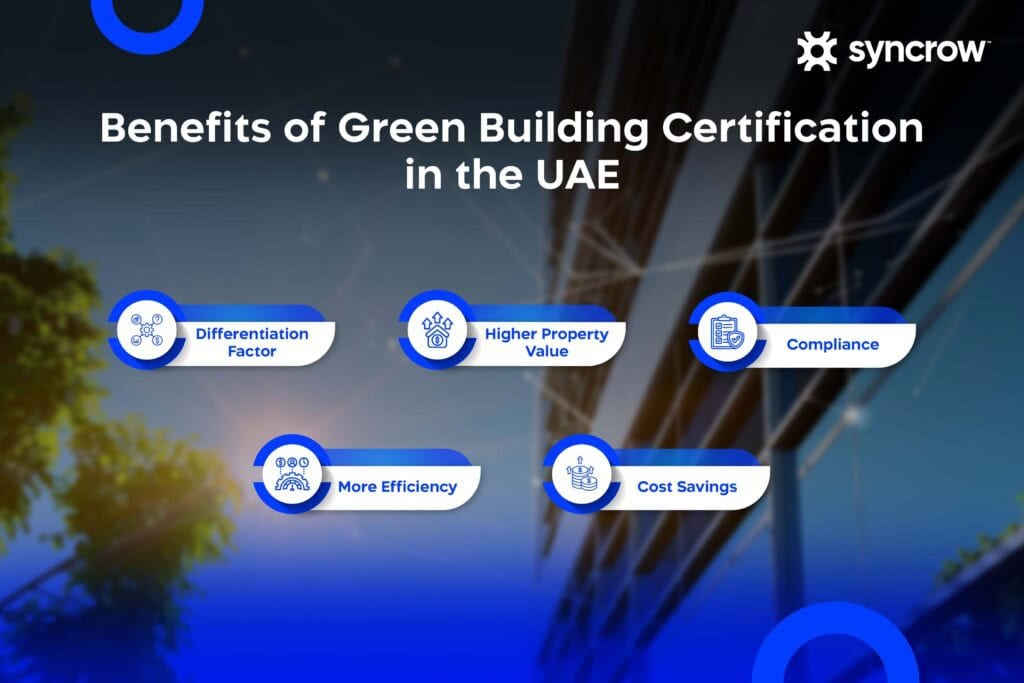
Compliance
In the UAE, compliance with local green building regulations and municipal mandates is becoming increasingly important. Many authorities require projects to align with sustainability frameworks. Certification ensures that projects meet regulatory standards, including green building regulations and specifications, reducing the risk of delays or penalties during approval stages.
It also demonstrates alignment with national sustainability and climate commitments, which is critical for public sector developments and large-scale master plans.
According to PWC, the UAE’s Federal Decree-Law No. (11) of 2024 on the Reduction of Climate Change Effects came into effect on 30 May 2025. This law requires covered entities to measure, report, and work toward reducing their greenhouse gas (GHG) emissions. Companies in the UAE must ensure readiness and compliance before the reporting deadline, which is on May 30, 2026.
Higher Property Value
Buildings with green building certification often command higher asset value. Investors recognize that sustainable properties typically have lower operational risks and better long-term performance. Tenants are also willing to pay premiums for healthier and more efficient spaces.
In competitive markets like Dubai and Abu Dhabi, certified properties can stand out in leasing and sales negotiations, especially among multinational companies that prioritize ESG reporting and sustainable portfolios.
Differentiation Factor
Certification acts as a market differentiator. In a crowded real estate landscape, a recognized certificate signals quality, innovation, and environmental commitment. Developers who achieve green building standards position themselves as forward-thinking leaders within the construction industry.
For commercial landlords, it becomes a branding asset that attracts international tenants seeking environmentally responsible spaces.
More Efficiency
Certified buildings are designed and operated with performance in mind. Through optimized building systems, efficient lighting, smart HVAC systems, and smart controls, these projects reduce unnecessary energy use and water waste.
Improved energy use management and enhanced indoor environmental quality contribute to better occupant comfort and productivity, while data-driven monitoring ensures consistent performance of buildings over time.
Cost Savings
Although pursuing green building certification requires upfront planning, the long-term cost savings are substantial. Reduced energy and water consumption translates into lower utility bills, while efficient maintenance practices extend equipment lifespan.
Lower operational costs improve return on investment and enhance the building’s financial feasibility. For many developers, the lifecycle savings outweigh the initial certification expenses.
Top Green Building Certifications in the UAE
Several certification frameworks are recognized across the UAE. Some are international systems, while others are locally developed to address regional climate and policy priorities.
The UAE recognizes multiple green building certification systems, including international frameworks such as LEED and BREEAM, as well as local rating systems like Estidama and Al Sa’fat:
Estidama
Estidama is the sustainability framework developed specifically for Abu Dhabi. The name means “sustainability” in Arabic and reflects the emirate’s long-term environmental vision. At the core of Estidama is the Pearl Rating System, which evaluates buildings based on water, energy, materials, and community impact.
The Pearl Rating System is mandatory for many government-funded developments in Abu Dhabi. It focuses strongly on water conservation due to the region’s scarcity challenges. By integrating sustainability into design and construction from early planning stages, Estidama ensures projects align with local environmental priorities.
LEED
LEED (Leadership in Energy and Environmental Design) is one of the most widely recognized global certification frameworks. Developed by the U.S. Green Building Council, it is widely popular in Dubai and across the UAE.
LEED certification evaluates categories such as energy efficiency, water management, materials, indoor air quality, and site sustainability. Projects earn points and receive different levels of recognition based on their performance.
Many multinational corporations prefer LEED because of its international credibility. In Dubai’s commercial sector, LEED has become a benchmark for premium office towers, smart hotels, and mixed-use projects seeking global recognition.
GBRS
The Green Building Regulations and Specifications (GBRS) were introduced in Dubai to establish mandatory sustainability criteria for new developments. Rather than being a voluntary international certification, GBRS acts as a regulatory framework to ensure baseline environmental performance.
It sets minimum standards for energy and water efficiency, materials, and building systems. While not always marketed as a traditional certification, compliance demonstrates adherence to Dubai’s environmental objectives.
WELL Building Standard
The Well Building Standard focuses primarily on human health and wellness. Unlike systems centered on energy and water, WELL emphasizes air, light, comfort, and occupant well-being.
By improving indoor air quality and thermal comfort, WELL-certified projects support healthier work and living environments. For corporate offices and hospitality spaces in Dubai and Abu Dhabi, WELL is often pursued alongside LEED to address both environmental and human-centered goals.
BREEAM
BREEAM, which stands for Building Research Establishment Environmental Assessment Method, is a UK-based sustainability assessment method used internationally. It evaluates environmental performance across design, construction, and operation.
Although less common than LEED in the UAE, BREEAM is sometimes selected for projects with strong European stakeholder involvement. It assesses environmental impact, management practices, and resource efficiency across the building lifecycle.
Al Sa’fat Certification
Al Sa’fat is Dubai Municipality’s green building rating framework for new buildings. It aligns closely with local climate conditions and urban development priorities.
This rating system categorizes buildings into multiple tiers based on compliance with sustainability benchmarks, including Silver, Gold, and Platinum. It reinforces Dubai’s vision for sustainable development while ensuring that new projects meet specific requirements tailored to the local environment.
Comparing the Green Building Certifications in the UAE
There is no single best green building certification for every project. Each framework has advantages depending on project type, location, and stakeholder priorities.
Below is a general comparison between the green building certifications:
| Certification | Primary Focus | Geographic Relevance | Strength | Typical Use Case |
| Estidama (Pearl Rating System) | Water, energy, community | Abu Dhabi | Local regulatory alignment | Government & large developments |
| LEED | Energy, sustainability, global standards | International / UAE | Global recognition | Commercial, hospitality, mixed-use |
| GBRS | Regulatory compliance | Dubai | Mandatory baseline | All new Dubai projects |
| WELL Building Standard | Health & wellness | International | Human-centric design | Offices, hospitality |
| BREEAM | Environmental performance | International | European alignment | International-led projects |
| Al Sa’fat | Local sustainability criteria | Dubai | Municipality-backed framework | Residential & commercial |
How IoT Automation Supports Achieving Green Building Certification?
Achieving green building certification requires measurable data. IoT-enabled smart building automation solutions simplify this process by providing real-time insights into energy and water consumption, occupancy patterns, predictive maintenance, and system efficiency.
Smart meters and submetering solutions track usage by zone or tenant, helping meet documentation requirements during the certification process. Advanced automation optimizes smart HVAC systems to reduce energy use while maintaining comfort. Sensors continuously monitor indoor air quality, ensuring compliance with many standards.
With centralized dashboards, facility managers can oversee building systems, improve the performance of buildings, and generate sustainability reports. These technologies enhance feasibility during early feasibility studies and improve long-term building performance.
Conclusion
Green building certification has become a strategic priority in the UAE. From Dubai’s regulatory frameworks to Abu Dhabi’s green initiatives, certified sustainable buildings are shaping the future. Beyond compliance, certification improves asset value, operational efficiency, and occupant wellbeing while reducing environmental impact.
If you are planning a new development or upgrading an existing asset, Syncrow can help you get started. Our smart building solutions support data collection, automation, and optimization, forming the cornerstone to align with leading certification frameworks. Talk to Syncrow today for a free consultation and discover how intelligent building systems can support your sustainability goals.
FAQs
What is a green building certification?
Green building certification is an official recognition that a building meets established environmental performance standards related to energy efficiency, water conservation, materials, and indoor environmental quality.
Can submetering be used for green building certifications?
Yes, submetering helps track energy and water usage by area or tenant, providing detailed performance data often required in certification frameworks such as LEED.
How do you obtain green building certification?
To obtain green building certification, projects must meet defined criteria, submit documentation, undergo review, and demonstrate compliance with the selected rating system.
Which certification is most commonly used in Dubai?
Among the available options, LEED is widely adopted in Dubai due to its international recognition, alongside compliance with local frameworks such as Al Sa’fat.
Is it possible to retrofit existing buildings in Dubai for certification?
Yes, existing buildings can be upgraded with efficient HVAC systems, improved insulation, smart monitoring, and water-saving technologies to qualify for green certification programs.