Rising energy costs and inefficient building operations are putting growing pressure on commercial properties across the UAE, making cost savings in smart buildings a critical priority. As businesses focus more on efficiency, cost savings in smart buildings have become increasingly important to avoid unnecessary resource waste.
IoT-powered smart building solutions help optimize energy usage, automate operations, and improve maintenance efficiency through connected sensors, centralized controls, and cost savings analysis. These energy-efficient smart solutions reduce waste, improve workflow, and support better operational decisions.
This blog explores rising building costs, key cost savings areas, cost reduction IoT solutions, smart building ROI, implementation challenges, and the future of IoT-based energy-efficient solutions.
Why Operational Costs Are Rising in Modern Buildings
Rising energy usage, inefficient workflows, and delayed maintenance are part of the reasons that make modern buildings consume significant resources daily, making operational expenses difficult to manage. Here is a short list of direct reasons:
- Energy consumption remains the largest expense.
- Manual facility management creates inefficiencies.
- Maintenance costs increase without early detection.
Energy Consumption Remains the Largest Expense
Heating, cooling, lighting, and continuously operating equipment contribute heavily to operational costs. Without a professional smart energy management system, buildings often consume more electricity than is actually needed, leading to a significant increase in the monthly utility expenses.
Manual Facility Management Creates Inefficiencies
Traditional facility management relies heavily on manual monitoring and human intervention. Whether management is done by shifts or during standard working hours, this approach slows response times, reduces operational visibility, and increases the likelihood of unnecessary energy and resource waste.
Maintenance Costs Increase Without Early Detection
Undetected equipment issues can quickly escalate into expensive repairs, productivity decrease, and operational disruptions. Without real-time monitoring and predictive maintenance alerts, maintenance teams often respond only after failures occur, which will cost more.
Cost Saving Areas in Smart Buildings
Smart buildings reduce operational costs by improving energy management, automating maintenance processes, and streamlining daily building operations, leading to more efficient smart business on different levels. An energy-saving IoT system helps organizations monitor performance, optimize resources, and increase cost savings more efficiently. One of the biggest opportunities is improving energy efficiency in buildings through smart monitoring, automation, and optimized resource use. The main cost saving areas are:
- Energy efficiency.
- Predictive maintenance.
- Operational efficiency.
Energy Efficiency
Smart systems optimize lighting, HVAC, and equipment usage based on occupancy, schedules, and environmental conditions for better cost savings. This cost reduction strategy reduces unnecessary electricity consumption while improving energy efficiency throughout the building.
Predictive Maintenance
Predictive maintenance is a key area in cost savings, especially when teams can fix performance issues before they become a major breakdown that requires repair or replacement, and stop the workflow. IoT smart sensors continuously monitor equipment performance and identify abnormalities, even small ones, before failures happen. Predictive maintenance reduces repair costs, minimizes downtime, and extends the lifespan of building systems and assets.
Operational Efficiency
An efficient smart energy-saving solution starts with centralized smart building automation and energy performance platforms to automate repetitive tasks and simplify facility operations. Cost savings automation improves workflow efficiency, reduces manual intervention, and enables faster responses to operational issues and system alerts.
How Smart Buildings Reduce Operational Costs
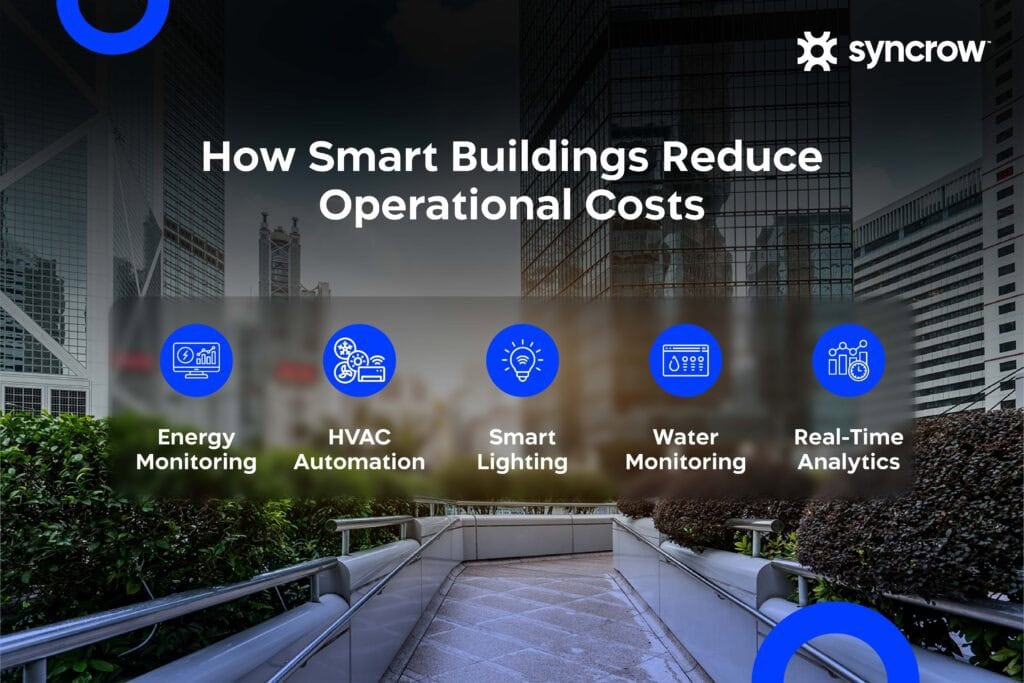
IoT-enabled smart building solutions use connected technologies to automate operations, monitor resource usage, and optimize building performance. These cost reduction solutions help reduce waste, improve efficiency, and lower long-term operational expenses effectively. Most effective smart solutions in cost reduction are:
- Smart energy monitoring reduces electricity waste.
- Automated climate control improves HVAC efficiency.
- Smart lighting prevents unnecessary energy usage.
- Water monitoring helps prevent hidden losses.
Smart Energy Monitoring Reduces Electricity Waste
Most businesses think about how to save electricity, and smart energy monitoring systems provide real-time visibility into electricity consumption patterns with smart plugs, monitors, and data. With office efficiency software Dubai, facility managers can identify energy waste, optimize equipment performance, and make informed decisions to reduce operational costs.
For example, large office towers in Dubai International Financial Centre (DIFC) use centralized energy monitoring systems to improve electricity efficiency across commercial spaces.
Automated Climate Control Improves HVAC Efficiency
Smart thermostats and environmental sensors automatically adjust cooling and heating systems based on occupancy and temperature conditions. This improves HVAC efficiency to keep a balanced indoor environment and ensure workplace wellbeing while reducing unnecessary energy usage across different building areas.
For example, in the UAE, smart climate automation is becoming increasingly important in hotels and commercial buildings to manage cooling costs during peak summer temperatures.
Smart Lighting Prevents Unnecessary Energy Usage
Occupancy sensors and automated lighting systems ensure lights operate only when needed. Smart lighting reduces electricity consumption, lowers utility expenses, and improves overall energy efficiency throughout the building.
For example, several modern shopping malls in Dubai use automated lighting systems that adjust brightness levels based on daylight availability and visitor movement.
Water Monitoring Helps Prevent Hidden Losses
Smart water meters and leak detection sensors monitor water consumption continuously. Real-time alerts help facility teams detect leaks early, prevent water waste, and, most importantly, avoid costly property damage repairs.
For example, in large UAE hospitality projects, smart water monitoring helps hotels reduce water waste and improve operational efficiency.
Cost Savings: Traditional Building vs Smart Building
The differences between traditional and IoT-enabled smart buildings become clearer when comparing daily operations, maintenance strategies, cost savings, and resource management capabilities.
| Area | Traditional Building | IoT-Enabled Smart Building |
| Energy Monitoring | Manual checks and monthly bills | Real-time monitoring and analytics |
| HVAC Control | Fixed schedules and manual adjustments | Automated temperature optimization |
| Lighting | Lights remain on unnecessarily | Occupancy and daylight-based automation |
| Water Management | Leaks detected manually | Instant leak detection and alerts |
| Maintenance | Reactive maintenance after failures | Predictive maintenance with alerts |
| Operational Visibility | Limited system insights | Centralized monitoring dashboard |
| Resource Efficiency | Higher waste and inefficiencies | Optimized resource usage |
| Operating Costs | Higher long-term expenses | Reduced utility and maintenance costs |
Smart Building ROI: Where Businesses See the Biggest Savings
The best energy saving tips highlight the power of cost savings with smart building technologies. This is because of the high smart building ROI with measurable financial benefits, including reduced utility costs, improved maintenance efficiency, and optimized daily operations. Businesses can achieve long-term savings while improving building performance and occupant comfort. The key ROI of smart buildings are:
- Lower electricity bills.
- Reduced maintenance costs.
- Lower water consumption.
- Extended equipment lifespan.
- Better occupant comfort and productivity.
Lower Electricity Bills
Smart automation reduces unnecessary energy usage by optimizing lighting, HVAC systems, and equipment schedules. Real-time monitoring also helps identify wasteful consumption patterns and improve electricity efficiency.
Reduced Maintenance Costs
Predictive maintenance technologies are a key pillar in cost savings. It helps detect equipment issues before failures occur. Early intervention reduces emergency repair costs, minimizes downtime, and helps maintenance teams operate more efficiently across facilities.
Lower Water Consumption
Smart water monitoring systems identify leaks and unusual consumption patterns quickly. This helps businesses reduce water waste, lower utility expenses, and prevent costly infrastructure damage caused by undetected leaks.
Extended Equipment Lifespan
Optimized equipment operation reduces excessive wear and unnecessary strain on building systems. Predictive maintenance and smart automation help extend the lifespan of HVAC systems, lighting, and other infrastructure.
Better Occupant Comfort and Productivity
Smart climate control, lighting automation, and indoor environmental monitoring improve occupant comfort. Comfortable environments can support productivity, enhance user experience, and contribute to overall workplace satisfaction.
Challenges to Consider Before Implementing Smart Building IoT
Smart building implementation requires careful planning to ensure successful integration, scalability, and long-term performance. Organizations should evaluate technical requirements, operational goals, and infrastructure readiness before deployment.
- Initial Investment: High upfront investments in devices, infrastructure, and integration technologies before long-term operational savings become visible.
- Integration Planning: Require a proper integration planning to ensure seamless communication and centralized operational control.
- Connectivity Requirements: Reliable network connectivity is essential for stable communication between IoT devices, sensors, and centralized platforms.
- Choosing Scalable Platforms: Organizations should select scalable smart building platforms that can support future expansion and additional devices.
The Future of Cost Savings in Smart Buildings
Smart building technologies continue evolving as organizations focus on automation, sustainability, and operational intelligence. Future smart buildings will rely more heavily on AI, cost saving analysis, and connected ecosystems. Cost savings in smart building could be shortlisted as:
- AI-driven optimization.
- Greater automation.
- Sustainability goals.
- Smarter resource allocation.
AI-Driven Optimization
Artificial intelligence will help buildings automatically optimize energy usage, maintenance schedules, and operational performance using real-time data analysis.
Greater Automation
Smart office automation will reduce manual intervention by enabling smarter decision-making in lighting, HVAC, security, and other smart systems.
Sustainability Goals
The Al Sa’fat system in Dubai is part of the Net Zero 2050 strategy in the UAE, which requires all new developments to meet strict standards for energy efficiency. Smart buildings support sustainability initiatives by reducing energy waste, lowering carbon emissions, and improving environmental performance across facilities.
Smarter Resource Allocation
Future IoT systems will improve how buildings allocate electricity, water, and operational resources based on occupancy patterns and real-time demand.
Final Thoughts
Smart buildings are transforming how organizations manage operational costs, energy consumption, and facility performance. IoT technologies help businesses improve cost savings and efficiency through automation, predictive maintenance, and real-time resource monitoring.
Syncrow, a smart building solution provider in the UAE, provides integrated smart building solutions designed to improve cost savings, automate building management, and optimize resource usage through advanced IoT technologies. From smart energy monitoring and climate control to predictive maintenance and automation systems, Syncrow helps businesses build smarter and more efficient environments. Book a smart building consultation with Syncrow to reduce operational costs through smart automation and IoT-driven energy management.
FAQs About Cost Savings in Smart Building
What Is a Smart Building?
A smart building uses connected technologies, IoT devices, and automation systems to monitor and manage lighting, HVAC, security, curtains, energy consumption, and other operational systems more efficiently.
What Are Examples of Smart Buildings?
Examples of smart buildings include automated offices, smart hotels, connected residential towers, intelligent hospitals, and commercial facilities using IoT systems for energy management and operational automation.
How Do Smart Buildings Save Energy?
Smart buildings save energy by automating lighting, optimizing HVAC operations, monitoring electricity usage, and adjusting systems based on occupancy, schedules, and real-time environmental conditions.
Can Smart Buildings Lower HVAC Costs?
Smart buildings reduce HVAC costs through automated climate control, occupancy-based temperature adjustments, smart thermostats, and environmental sensors that optimize heating and cooling efficiency.
How Do Smart Sensors Help Reduce Utility Costs?
Smart sensors monitor occupancy, lighting, temperature, water usage, and equipment performance in real time, improving cost savings in buildings, reducing waste, and enhancing operational efficiency.
How Does IoT Reduce Energy Consumption in Buildings?
IoT systems provide real-time monitoring, automation, and analytics that help buildings optimize electricity usage, reduce unnecessary consumption, and improve energy management across multiple systems.
What Is Predictive Maintenance in Smart Buildings?
Predictive maintenance uses IoT sensors and data analytics to identify equipment issues before failures occur, helping businesses reduce repair costs, prevent downtime, and extend equipment lifespan.