Choosing the best smart thermostat in the UAE starts with one practical question: will it work with the home’s cooling system? For any smart thermostat Dubai homeowners consider, compatibility should come first, whether the property uses split AC, central AC, or a chiller/FCU system.
Many global smart thermostat comparisons are built around markets where heating is a major priority. UAE homes need a cooling-first view. AC runtime, wiring, control type, room layout, building infrastructure, and local installation support all affect whether a thermostat is suitable.
This guide compares the main AC thermostat options for UAE homes, explains which type fits each cooling setup, reviews cost and installation factors, and helps buyers avoid incompatible products, unsupported setups, and unrealistic energy-saving claims.
Traditional vs Smart AC Thermostat
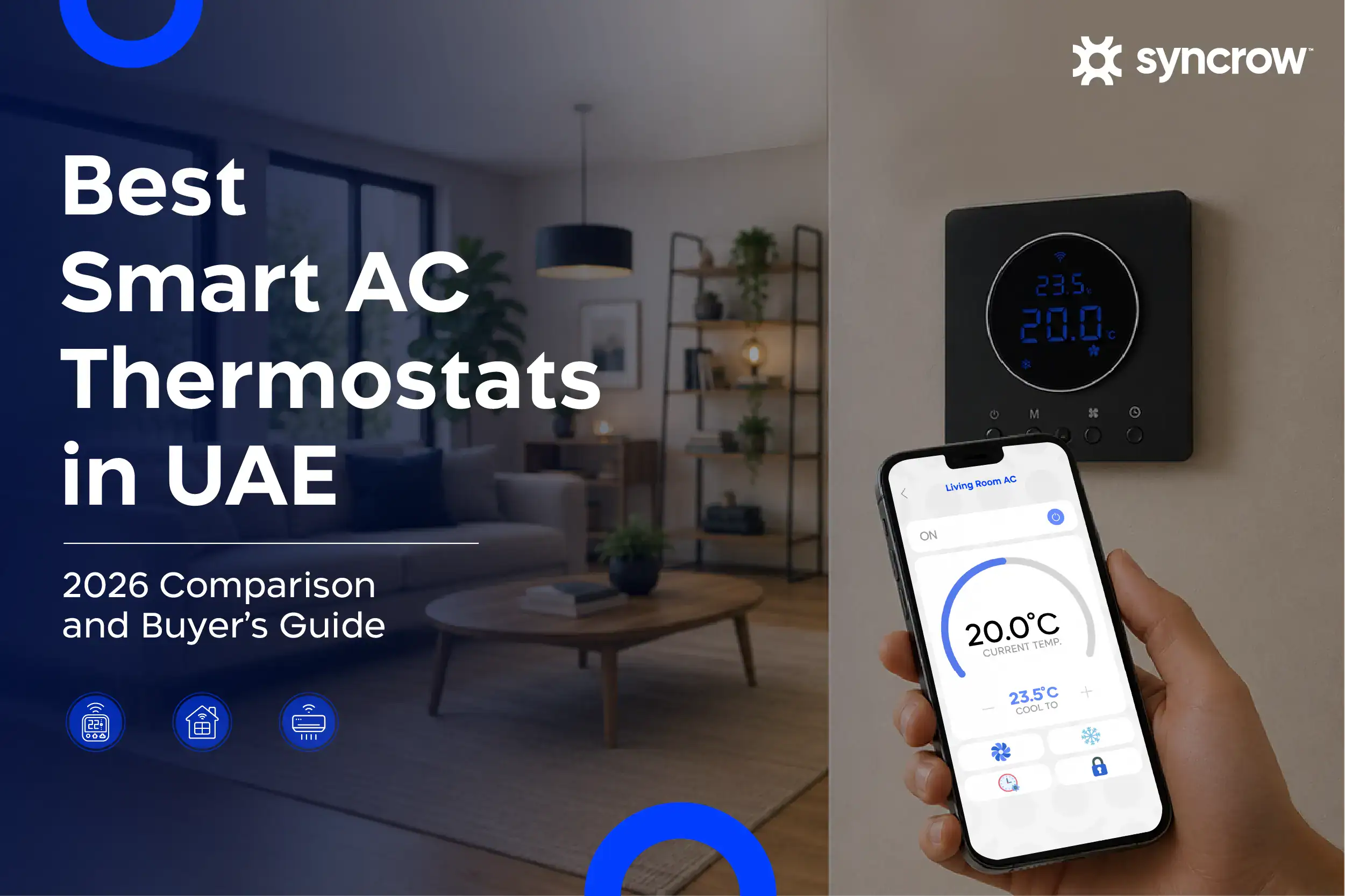
A traditional AC thermostat provides basic temperature control, while a smart thermostat can add app control, scheduling, voice control, time functions, fan-speed control, setpoint adjustment, and connected automation. The real value depends on whether those features match the installed AC system.
| Comparison Point | Traditional AC Thermostat | Smart AC Thermostat |
| Main function | Manual temperature control | Temperature control with added smart features |
| Access | Usually wall-based only | Wall control, app access, and sometimes voice control |
| Scheduling | Limited or unavailable | Often supports schedules and time functions |
| Remote control | Usually unavailable | Available when app or connected control is supported |
| Automation | Not usually supported | May support smart linkage, scenes, or sensor-based logic when connected to compatible smart home devices and a wider setup |
| Best for | Basic cooling control | Homes that need convenience, visibility, and more flexible AC control |
Best Smart AC Thermostat Options in the UAE Compared
The best smart thermostat for a UAE home depends on the AC control method, smart features, installation complexity, room use, and local support after installation. No single option fits every setup, so buyers should compare solution types before choosing.
| Solution Type | Compatibility Check | Smart Features | Installation Complexity | Best For | Cost Range |
| Smart AC Controller | Works with compatible AC units that use handheld remote control | App control, schedules, remote access | Low to medium | Bedrooms, apartments, and single-room upgrades | Starting from entry-level |
| Hardwired Smart Thermostat | Requires compatible wiring, voltage, and control terminals | Scheduling, app control, sensor support | Medium | Wired wall-control setups and selected ducted systems | Starting from mid-range |
| Imported Smart Thermostat Options | Depends on voltage, wiring, warranty, and local installation support | App control and smart integrations | Medium to high | Selected compatible systems only | Starting from mid to premium |
| Local WiFi Thermostat or Digital Thermostat | Varies by model, wiring, and control type | App or manual control, depending on model | Low to medium | Basic upgrades and simple control needs | Starting from entry-level |
| Zigbee Wall-Mounted Smart AC Thermostat | Works where wiring, fan load, and AC control type support it | App control, time function, voice control, fan speed, setpoint control | Medium | Connected wall-based AC control in compatible rooms or zones | Starting from mid-range |
Split AC vs Central AC vs Chiller: Which AC Thermostat Fits Your Home?
AC system type determines which thermostat will fit a UAE home. Split AC, central AC, and chiller/FCU systems use different control methods, so buyers should confirm the cooling setup before comparing smart features or installation options.
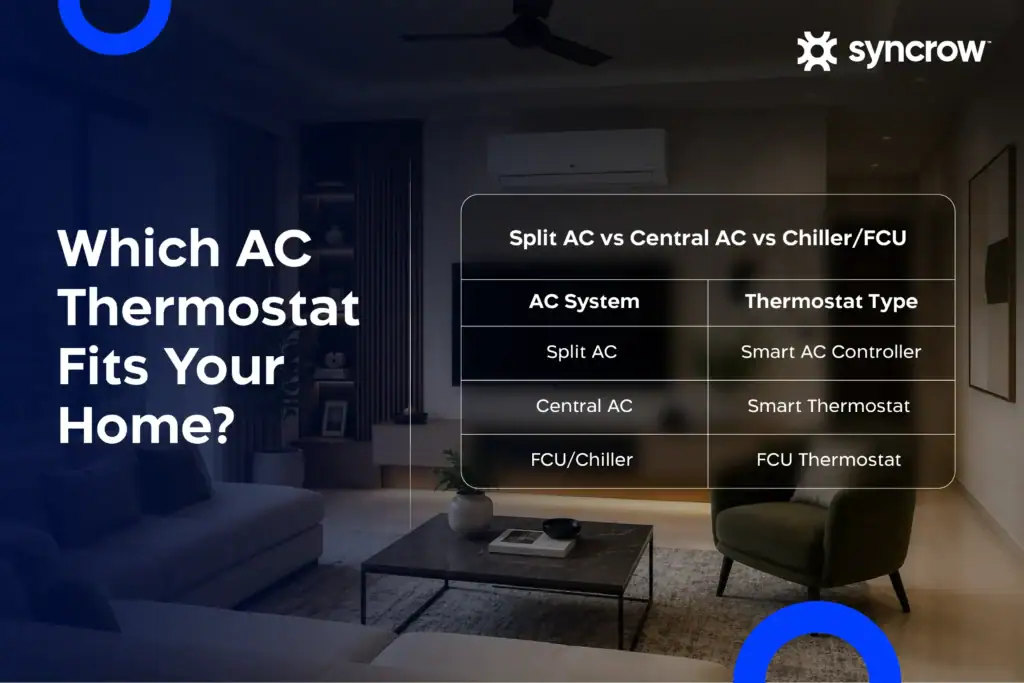
Split AC Systems
Split AC systems often work best with a smart AC controller or an IR blaster / wireless AC controller when the unit uses a handheld remote. This can suit bedrooms, apartments, smaller rooms, and no-rewiring upgrades.
Central AC Systems
Central AC systems may need hardwired smart thermostats, especially in homes with ducted cooling, wall control, multiple zones, or room-by-room control needs. Compatibility depends on wiring, voltage, and the existing control setup.
Chiller and FCU Systems
Chiller and FCU systems need careful thermostat matching because fan-speed control, valve control, and building-system compatibility matter. Buyers should confirm whether the thermostat is approved for the building’s cooling setup before installation.
| AC System | Common in UAE | Thermostat Type |
| Split AC | Apartments, bedrooms, smaller rooms, and selected villas | Smart AC controller, IR blaster / wireless AC controller |
| Central AC | Larger homes, villas with ducted cooling, and multi-zone setups | Hardwired smart thermostat or compatible wall-based smart thermostat |
| Chiller/FCU | Towers, apartments, and managed buildings | FCU thermostat, chiller-compatible thermostat, or building-approved control |
Smart Thermostat or Integrated AC Automation: Which Should You Choose in the UAE?
A smart thermostat is usually enough for one compatible room, zone, or AC unit. Integrated AC automation is more suitable when cooling needs to coordinate across multiple rooms, schedules, sensors, and connected systems.
Smart Thermostat
A smart thermostat, WiFi thermostat, or smart AC controller may suit one room, simple scheduling, remote access, and basic comfort control when the installed AC system is compatible.
Integrated AC Automation
Integrated AC automation suits multi-room homes, villas, and connected spaces where cooling needs to work with sensors, curtains, lighting, scenes, schedules, access, and centralized control.
Features to Compare Before Buying an AC Thermostat in Dubai
Before buying an AC thermostat in Dubai, compare compatibility first, then temperature visibility, retrofit needs, app control, smart home integration, sensor support, supplier support, installation requirements, warranty, and total cost. The best option is the one that fits the cooling system and daily use.
AC System Compatibility
Compatibility should cover split AC, central AC, chiller, FCU, voltage, wall control, remote control, fan speed, valve requirements, and zoning. The right thermostat is the one that matches the existing cooling system.
Temperature Data and Usage Visibility
Temperature data and usage visibility help homeowners understand cooling patterns, repeated runtime, and inefficient habits. Paired with scheduling, setpoint discipline, and room-by-room control, these insights support better cooling decisions. Some buyers may compare a smart thermostat with air quality features, where supported, but cooling compatibility remains the priority.
Retrofit and No-C-Wire Requirements
Some hardwired smart thermostats need continuous power, while some split AC controllers avoid rewiring through wireless or IR-based control. Older homes, rentals, and finished interiors need careful C-wire / no-C-wire retrofit planning.
App Control, Smart Home Integration, and Sensor Support
App control should make daily cooling easier through remote access, schedules, and clear temperature settings. Smart home integration and sensor support are useful when they connect AC control with real room use, sensor input, scenes, or other compatible systems.
UAE Supplier, Warranty, and Installation Support
Before choosing between thermostat suppliers in UAE, check whether they can support compatibility checks, installation, troubleshooting, warranty, replacement, and building-specific requirements. Unsupported imported products can become difficult to maintain, even when the app experience looks strong.
Can a Smart AC Thermostat Reduce Your DEWA Bill?
A smart AC thermostat can help reduce AC consumption when it improves cooling behavior, but it should not be treated as a guaranteed bill-cutting device. The strongest value usually comes from scheduling, away modes, remote control, supported occupancy logic, and better setpoint discipline.
The DEWA 24°C guidance recommends keeping the thermostat set at 24°C or higher and notes that each degree increase in setpoint can save up to 5% on AC consumption. DEWA also recommends using a smart thermostat to better control room temperature and AC operation duration.
Fixed 50% savings claims are usually misleading without a baseline. Results depend on AC type, AC age, filter maintenance, heat gain, cooled-air leakage, usage habits, room occupancy, property size, thermostat settings, and whether the system actually reduces unnecessary runtime.
Thermostat Price in UAE: Device Cost, Installation Cost, and Payback
The thermostat price in UAE depends on AC type, wiring, room count, installation scope, supplier support, and whether the setup is a single-room device or part of wider automation. Buyers should compare total setup requirements, not the device alone.
Smart Thermostat Cost Ranges in the UAE
The cost of smart thermostat upgrades usually starts lower for smart AC controllers, WiFi thermostats, and digital thermostats. Hardwired smart thermostats, FCU thermostats, Zigbee wall-mounted thermostats, and wider automation usually start higher.
Smart Thermostat Installation Cost in the UAE
Smart thermostat installation cost depends on wiring, AC type, wall access, fan-speed control, number of zones, and whether the thermostat needs configuration with a wider smart home system or building setup.
Factors That Affect Smart Thermostat Payback in the UAE
The smart thermostat payback period depends on upfront cost, installation scope, cooling habits, AC runtime, setpoint discipline, insulation, AC maintenance, room occupancy, and whether the thermostat reduces unnecessary cooling instead of only adding app control.
Final Thoughts
The best smart thermostat for a UAE home is not the option with the most app features. It is the option that matches the cooling system, wiring, room layout, installation requirements, and long-term support from the start.
A smart AC thermostat delivers stronger results when connected with occupancy sensors, smart curtains, schedules, and centralized control. Syncrow helps homeowners across Dubai, Abu Dhabi, and the UAE plan integrated AC automation systems that reduce unnecessary cooling in empty rooms, limit solar heat gain, improve comfort, and fit the property’s existing cooling setup. Book a free smart home consultation.
FAQs About AC Thermostats in the UAE
What Is the Best Smart AC Thermostat in Dubai?
The best smart thermostat for AC in Dubai is the one that matches the home’s cooling system, wiring, and control method. For most buyers, compatibility matters more than app design, brand popularity, or extra features.
Does a Smart Thermostat Work With Split AC?
Yes, a smart thermostat can work with split AC when the control method is compatible. Many split AC units use handheld remotes, so smart AC controllers and IR blaster / wireless AC controller options are often more suitable than hardwired thermostats.
How Much Does a Smart Thermostat Cost in the UAE?
The cost of smart thermostat options in the UAE depends on device type, AC system, wiring, supplier support, and installation scope. Basic controllers may start lower, while hardwired, FCU, Zigbee, or integrated automation setups usually start higher.
How Much Can a Smart Thermostat Cut My DEWA Bill?
A smart thermostat can help reduce unnecessary AC use through schedules, away modes, remote control, and better setpoint discipline. Actual savings depend on AC runtime, insulation, usage habits, maintenance, property size, and the DEWA 24°C guidance.
Can a Smart Thermostat Really Save 50%?
A smart thermostat should not be expected to save 50% by default. Savings depend on the current cooling baseline, AC type, insulation, maintenance, occupancy, thermostat settings, and whether unnecessary cooling runtime is actually reduced.
Do I Need a C-Wire for a Smart AC Thermostat?
Some hardwired smart thermostats need a C-wire or continuous power source, but not every AC setup does. C-wire / no-C-wire retrofit planning depends on thermostat type, wiring, voltage, AC system, and whether the controller uses wireless or IR-based control.