Workplace wellbeing has become a key factor in modern business performance. Companies increasingly recognize the importance of workplace wellbeing in smart offices in supporting employee productivity, engagement, motivation, and efficiency.
Smart offices play an important role in maintaining a balanced work environment by using IoT technologies and automated systems. These intelligent systems continuously monitor workplace conditions, such as lighting, air quality, and temperature, and adjust them in real time to maintain comfortable environments.
This blog explores health and wellbeing in the workplace, how IoT technologies improve workplace environments, the smart devices that support employee health, and what organizations should consider when implementing smart office solutions.
What Is Workplace Wellbeing in Modern Offices?
Workplace wellbeing in smart offices refers to creating environments that support employees’ physical comfort, mental and emotional health, and overall productivity. It includes factors such as indoor air quality, proper lighting, temperature control, and noise management. A well-designed and controlled office environment directly influences employee health, focus, energy levels, job satisfaction, and overall work performance.
Smart offices integrate smart devices and IoT systems to monitor, control, and maintain balanced workplace environments. This helps companies create and maintain healthier, more responsive, and balanced workspaces for their teams. Wellbeing in the workplace is the concept of providing the best work conditions for employees to ensure they deliver the best outcomes in all operations and projects.
Why Is Wellbeing Important in the Workplace?
Organizations are increasingly investing in workplace wellbeing because the office environment directly affects employee health, engagement, and performance. These factors also influence business outcomes, stability, and growth.
Here are the main reasons why workplace wellbeing is important:
- Better performance and productivity
- Higher employee satisfaction
- Improved retention
- Reduced sick days
- Lower turnover rate
- Enhanced financial efficiency
Better Performance and Productivity
Employees perform better when their work environment supports concentration, comfort, and energy levels. Smart offices ensure proper lighting, air quality, and temperature to help reduce fatigue, allow teams to focus longer, complete tasks faster, and maintain consistent productivity throughout the workday.
Higher Employee Satisfaction
Establishing workplace wellbeing in smart offices helps employees feel valued and supported, leading to higher job satisfaction, stronger engagement, better retention rates, and a more positive workplace culture across teams.
Improved Retention
Employees, especially high-skilled ones, are more likely to stay with organizations that invest in their wellbeing. Healthy and supportive work environments build trust and loyalty. This reduces the need for frequent hiring and helps companies retain experienced professionals while saving more on recruitment and training costs.
Reduced Sick Days
Poor office environments can cause headaches, fatigue, and respiratory issues. Effective workplace wellbeing in smart offices maintains healthy indoor conditions and better air quality. Companies that maintain workplace wellbeing experience lower health-related absences and better employee performance and attendance.
Lower Turnover Rate
High turnover can disrupt operations, increase recruitment costs, and impact project timelines. Smart offices help employees feel comfortable, healthy, and supported at work, making them less likely to leave. This helps businesses retain skilled employees, maintain stability, and ensure higher work quality.
Enhanced Financial Efficiency
Workplace wellbeing in smart offices directly impacts the company’s financial statistics. Workplace wellbeing improves productivity, reduces absenteeism, and lowers employee turnover, leading to better financial performance and operational efficiency.
How Smart Offices Improve Workplace Wellbeing with IoT Technology?
Smart offices use Internet of Things technology to connect devices, sensors, and building systems. These automated systems can monitor and adjust workplace conditions to ensure healthier and more comfortable indoor environments.
Automation
Automation in smart offices means that integrated systems such as lighting, climate control, and ventilation adjust automatically based on predefined settings, schedules, or real-time conditions. This ensures employees work in comfortable environments without the need for constant manual adjustments.
Real-Time Monitoring
IoT sensors continuously track environmental conditions such as air quality, temperature, humidity, and noise levels. Real-time monitoring triggers the automated actions to maintain a stable workplace environment.
Data-Driven Workspace Optimization
IoT platforms collect workplace data that helps organizations understand how spaces are used and how environmental conditions affect employees’ daily work. These real-time insights help leaders achieve better workspace design and more efficient workplace management.
5 Smart Devices That Improve Workplace Wellbeing
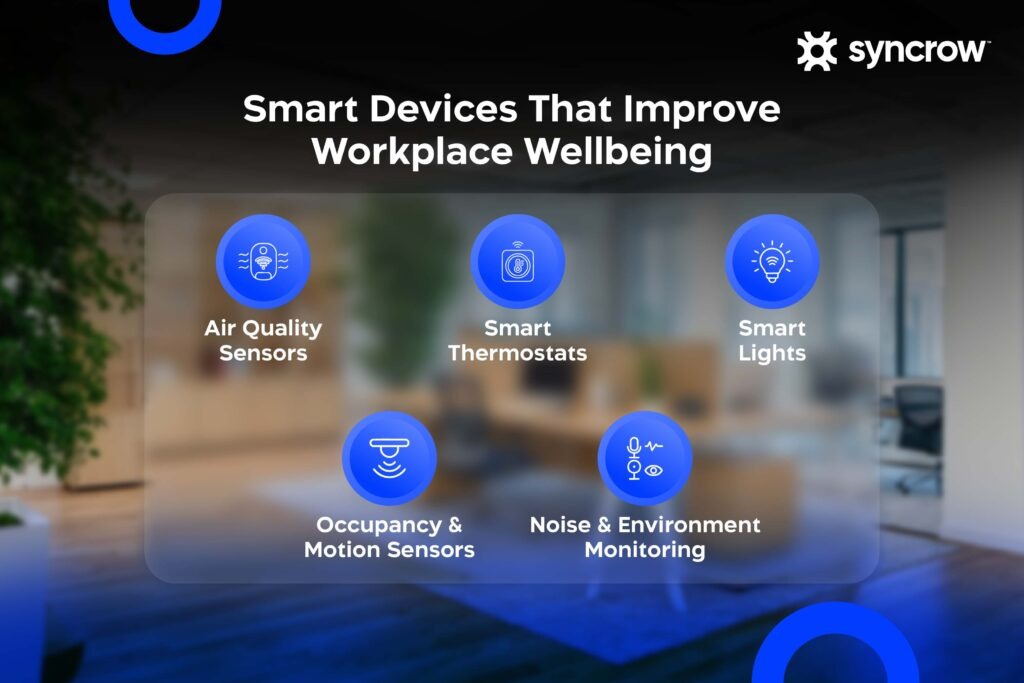
Workplace wellbeing in smart offices relies on essential smart devices with sensors and connected technologies to monitor environmental conditions and maintain healthier office environments for employees. These are the essential 5 smart devices included in offices with high workplace wellbeing indicators:
- Air quality sensors
- Smart thermostats
- Smart lighting systems
- Occupancy and motion sensors
- Noise and environment monitoring
1. Air Quality Sensors
Air quality sensors monitor indoor environmental conditions such as CO2, temperature, and humidity. By providing continuous data about indoor air quality, these sensors help facility managers maintain healthier air circulation, reduce indoor pollution risks, and support better respiratory health and concentration for employees throughout the workday. When integrated with a smart office system, these sensors can trigger the needed actions to ensure continuous air quality during working hours.
2. Smart Thermostats
Smart thermostats automatically adjust office temperature based on real-time conditions, occupancy, preferences, or predefined schedules. Maintaining a stable and comfortable temperature helps reduce fatigue and prevent overheating or cold discomfort. It also creates a balanced working environment that supports focus, productivity, and employee comfort.
Smart thermostats are also an energy-saving factor for offices, where they keep a balanced temperature without the need for continuously working cooling systems or active air conditioning systems in empty spaces.
3. Smart Lighting Systems
Smart lighting systems adjust brightness levels and color temperature throughout the day to match natural light cycles, occupancy, and workspace needs. Proper lighting reduces eye strain and supports visual comfort. It also helps employees maintain concentration, especially during long working hours or in offices with limited natural daylight.
People working in a space with improper lighting or a flickering light will focus more on the lighting rather than on working.
4. Occupancy and Motion Sensors
Occupancy and motion sensors detect when workspaces, meeting rooms, or shared areas are in use. This allows lighting, ventilation, and climate systems to be adjusted based on real-time presence. It improves employee comfort while helping organizations manage workspace efficiency and energy consumption.
5. Noise and Environment Monitoring Devices
Noise and environmental monitoring devices track sound levels and other workplace conditions to help maintain peaceful and productive office environments. They identify areas with high noise levels or environmental disruptions, which helps organizations take effective steps to improve noise comfort and support better concentration for employees.
How IoT Creates Data-Driven Workplace Wellbeing?
IoT platforms collect data from connected sensors across the workplace, including air quality monitors, temperature sensors, lighting systems, and occupancy devices. This information provides facility managers with real-time visibility into environmental conditions, allowing them to make the needed adjustments and updates to maintain healthier indoor environments and quickly solve issues affecting employee comfort.
By analyzing workplace data over time and identifying patterns, organizations can improve workspace design, adjust building systems, and create office environments that consistently support productivity, wellbeing, and operational efficiency.
Key Smart Office Benefits for Workplace Wellbeing
Smart offices offer a real impact on workplace wellbeing with all integrated systems. These smart office benefits are more noticeable with centralized and compatible smart systems.
Healthier Workspaces
Smart offices use connected sensors and automated systems to maintain healthy indoor environments. Monitoring air quality, temperature, and ventilation helps maintain healthy workplaces that support employee wellbeing and reduce environmental discomfort.
Improved Comfort
Automated lighting, climate control, and environmental management systems help maintain consistent and stable workplace conditions. Comfortable workspaces help employees stay focused and reduce physical strain during daily tasks.
Mental and Emotional Health
Balanced lighting, controlled noise levels, and comfortable indoor conditions are among the main factors that influence employee mood and mental wellbeing. These smart office benefits help reduce fatigue and support a calmer, more stable work atmosphere.
Better Productivity
Employees work more efficiently when workplace conditions support concentration and comfort. Smart office technologies help maintain stable environmental conditions that allow employees to focus on tasks without unnecessary distractions or the need to make adjustments to working devices.
Customized Workstations
Smart office systems allow workplaces to adapt to different employee preferences and workspace needs. Lighting, temperature, and desk environments can be adjusted to support individual comfort and improve the overall work experience. This customization feature is especially important in companies with hybrid teams, as workspaces can be adjusted based on different team requirements and schedules.
Reduced Stress
High noise levels, temperature variations, and poor lighting can increase workplace stress and cause employees to focus on conditions rather than actual work. Smart monitoring and automation help maintain stable and stress-free conditions, leading to a more relaxed and productive work environment.
Enhanced Safety and Security
Smart office systems integrate security and safety technologies such as access control, monitoring systems, and occupancy tracking. These solutions help maintain safer work environments and improve employee peace of mind.
Optimized Office Environments
Smart offices use workplace data to understand how spaces are used and how environmental conditions affect employees. Companies can use the collected data to adjust and develop the work environment to improve comfort, productivity, performance, efficiency, and space utilization.
Here is a summary of key smart office benefits for workplace wellbeing:
- Healthier workspaces
- Improved comfort
- Mental and emotional health
- Better productivity
- Customized workstations
- Reduced stress
- Enhanced safety and security
- Optimized office environments
Choosing the Right Smart Office Technology Provider
Businesses should consider several factors when selecting a professional smart office solution provider. These factors include local experience, system integration, scalability, reputation, quality of work, and after-sales support. Workplace wellbeing in smart offices is directly influenced by system performance, stable connectivity, and responsive technical support.
Working with an end-to-end smart solutions provider that offers local support and customizable platforms allows businesses to adapt workplace technology to operational needs, workforce size, and building infrastructure.
Smart Offices vs Traditional Offices: Key Metrics to Follow in the UAE
Many companies still question why they should invest in smart office solutions. However, this investment goes beyond adding devices to the workspace. It supports better productivity, safety, and workplace wellbeing.
Here is a direct comparison between smart and traditional offices:
| Feature | Smart Office | Traditional Office |
| Environmental Monitoring | Real-time sensors | Manual checks |
| Energy Management | Automated | Static systems |
| Workspace Utilization | Data-driven | Fixed layouts |
| Employee Comfort | Adaptive environments | Limited control |
| Maintenance | Predictive | Reactive |
| Performance | Higher and more stable | Less consistent |
Conclusion
Smart offices will continue to shape and support the future of workplace wellbeing with IoT technologies, automation, and data-driven workplace management. Smart automated offices can monitor and optimize workplace environments to create healthier workplaces that support employee comfort, productivity, and long-term operational efficiency.
At Syncrow, an end-to-end smart office solutions provider, we help companies improve workplace wellbeing with smart technologies, centralized control, environmental monitoring, and scalable IoT solutions. Learn what your business needs to ensure better workplace wellbeing with our free consultation.
FAQs About Workplace Wellbeing in Smart Offices
What Is Wellbeing in the Workplace?
Workplace wellbeing refers to the physical, mental, and emotional health of employees. It covers comfort, safety, air quality, lighting, and supportive work environments that enhance productivity, retention, and job satisfaction.
Why Workplace Wellbeing Matters?
Wellbeing is essential because healthy and comfortable employees perform better, engage more, and remain focused. Organizations benefit from higher productivity, reduced absence, lower turnover, and stronger overall business performance.
How to Promote Mental Health and Wellbeing in the Workplace?
Promote mental health through supportive office design, flexible work options, effective climate control, smart lighting, integrated sensors, and smart monitors to maintain good and stable indoor environments.
Do Employees Like Smart Offices?
Most employees appreciate smart offices because they provide comfortable, convenient, adaptive, and healthy work environments. Automated systems, improved air quality, optimized lighting, and efficient space usage enhance daily work experiences.
What Are the Benefits of a Smart Office?
Smart offices improve employee wellbeing, productivity, and engagement. They maintain optimal temperature, lighting, and air quality, reduce energy waste, enhance security, and provide data-driven insights for workspace optimization.
What Are the 5 Pillars of Employee Wellbeing?
The five pillars of employee wellbeing include physical health, mental and emotional health, financial wellbeing, social connections, and professional growth. Supporting all five areas improves satisfaction, performance, and workplace retention.