Lighting plays a major role in modern homes, influencing luxury, comfort, mood, functionality, and overall living experience. Traditional lighting systems often create daily inconveniences such as wasted electricity, limited control, and uneven brightness.
Smart lighting control systems have become increasingly important in UAE high-end homes and villas, where luxury living, energy efficiency, and convenience are highly valued. With rising electricity consumption and growing interest in smart home technology, homeowners are looking for smart lighting solutions that provide automated control, improve comfort, and support a more connected lifestyle.
This blog explores smart lighting systems, their main components, benefits, practical use cases, and how a smart lighting system works compared to traditional lighting solutions in modern UAE homes.
Why Smart Lighting Control Matters in UAE Homes?
A smart home light control system allows homeowners to automate, schedule, and manage lighting through connected systems, sensors, and mobile applications. These smart lighting systems improve convenience, enhance comfort, reduce unnecessary energy usage, and create a more luxurious living experience while supporting smarter and more efficient home management.
In the UAE, home lighting control is especially valuable due to large residential spaces, high cooling and electricity demands, luxury lifestyle expectations, and increasing focus on sustainability and energy efficiency.
What Is Smart Lighting Control?
Smart lighting is a connected system that allows lights to be managed automatically through switches, smart sensors, lighting schedules, mobile apps, or voice assistants. It helps optimize lighting usage, improve convenience, increase energy efficiency, and create personalized lighting experiences across different areas of a home.
Main Components of Smart Lighting System
A smart home lighting system combines multiple connected devices that work together to automate lighting control, scene activation, improve convenience, support energy efficiency, and create a more comfortable and modern home environment. These are the main components of a smart lighting system:
- Smart lights
- Smart switches and dimmers
- Control panels
- Occupancy sensors
- Motion sensors
- Timers and scheduling
Smart Lights
Smart home lights allow brightness, color temperature, and lighting schedules to be controlled via a centralized screen or remotely. These automatic lights help create personalized environments based on time, event, or mood.
Smart Switches and Dimmers
Smart dimmers and light switches are intelligent lighting controls with greater flexibility by allowing homeowners to control lighting intensity, automate schedules, and activate lighting scenes while maintaining a clean and modern wall design.
Control Panels
Control panels act as centralized interfaces that manage lighting, scenes, and connected smart devices from one location. They simplify home automation and provide convenient access to multiple controls.
Occupancy Sensors
Smart occupancy sensors automatically turn lights on or off depending on room usage. They improve convenience, safety, reduce energy waste, and help optimize lighting operation in residential environments.
Motion Sensors
These smart sensors detect movement and activate lighting automatically in hallways, entrances, staircases, including outdoor areas. They improve convenience, energy efficiency, safety, and security throughout the property.
Timers and Scheduling
Timers and scheduling functions automate lighting based on specific times or routines. This helps maintain consistent operation, improve convenience, and enhance security by sharing occupancy feelings with a scheduled timer switch for lights when the home is empty.
How Lighting Control Systems Work?
Lighting systems connect lights, switches, sensors, dimmers, apps, and smart controllers through wireless or wired communication technologies. These systems automate lighting operation based on schedules, occupancy, motion detection, or user preferences to improve convenience, luxury, efficiency, and living experience in modern homes and villas.
Connected devices in a light automation home system work together through centralized platforms that allow homeowners to manage lighting remotely, create custom scenes, automate routines, and enjoy a more comfortable, efficient, and luxurious smart home environment.
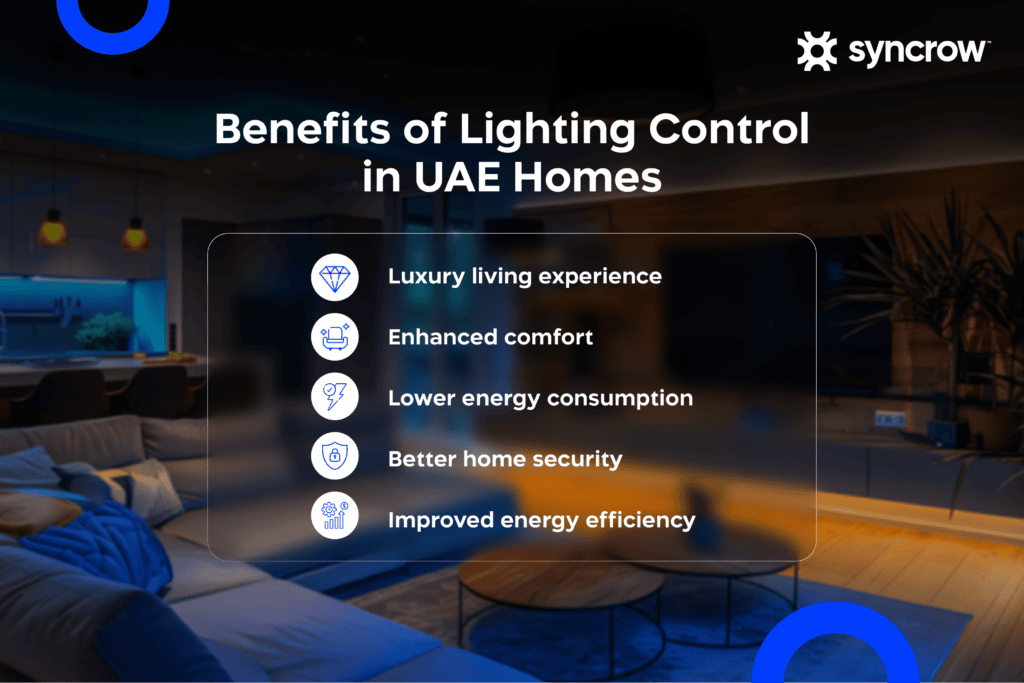
Benefits of Lighting Control in UAE Homes
Smart lighting control systems improve daily living by combining automation, convenience, luxury, and energy management. They help homeowners create smarter spaces while supporting comfort, security, and efficient electricity usage. The key benefits of lighting control in smart homes are:
- Luxury living experience
- Enhanced comfort and convenience
- Lower energy consumption and utility bills
- Better home security
- Improved energy efficiency
Luxury Living Experience
Smart lighting enhances luxury living by creating customized lighting scenes, elegant ambiance control, and seamless automation that aligns with modern lifestyle expectations in premium UAE homes.
Enhanced Comfort and Convenience
Automated lighting simplifies daily routines by adjusting brightness, activating scenes, and controlling multiple lighting zones through mobile apps, voice control, or centralized smart control panels.
Lower Energy Consumption and Utility Bills
Smart lighting systems can effectively reduce unnecessary electricity usage through automation, sensor usage, dimming, and scheduling features that help minimize lighting waste and lower monthly utility expenses.
Better Home Security
Lighting automation improves home security by activating lights during movement detection, especially in outdoor areas, simulating occupancy during vacations, and improving visibility around entrances, pathways, and outdoor spaces.
Improved Energy Efficiency
Efficient lighting control in smart lighting systems helps optimize electricity consumption by ensuring lights operate only when needed, supporting sustainable living and improving long-term energy management across residential properties.
Who Should Install Smart Lighting Control Systems?
Smart lighting control systems are ideal for modern living spaces in UAE where convenience, comfort, security, and energy efficiency are priorities. They are especially suitable for households and properties that require flexible lighting automation and centralized control.
- Villas
- Luxury apartments
- Families
- Frequent travelers
- Large homes
Smart Lighting vs Traditional Lighting: What Are the Differences
In the UAE, with its high expected living quality, smart house lighting control is becoming an important feature in modern UAE homes, while traditional lighting has fallen short in that. Understanding the differences between a smart lighting system and a traditional lighting system will help you set the best lighting system for your home.
| Feature | Smart Lighting Control | Traditional Lighting |
| Compatibility | Integrates with smart home systems and connected devices | Limited compatibility with automation systems |
| Cost | Higher initial investment with long-term savings | Lower upfront installation cost |
| Sustainability | Reduces energy waste through automation | Higher unnecessary energy consumption |
| Convenience | Remote access, automation, and scheduling | Fully manual operation |
| Luxury | Premium lighting scenes and smart experiences | Limited personalization |
| Remote Control | Controlled through apps and voice assistants | No remote functionality |
| Energy Efficiency | Optimized lighting usage through sensors and schedules | Lights often remain active unnecessarily |
| Scalability | Easily expandable with additional smart devices | Difficult to expand and automate |
Common Smart Lighting Scenarios in UAE Homes
Smart lighting control systems support practical automation scenarios that improve luxury, increase comfort, simplify routines, enhance security, and create a more connected living experience across modern UAE villas and homes. These common scenarios could include:
- Automatic night lighting
- Vacation and away modes
- Scheduled outdoor lighting
- Motion-activated hallway lighting
- Smart scene control for living rooms
Automatic Night Lighting
Smart lighting systems automatically activate low-brightness lighting during nighttime movement, improving visibility, comfort, and safety while reducing disruption and unnecessary electricity consumption.
Vacation and Away Modes
These modes automatically simulate occupancy by controlling lighting schedules while homeowners are away, helping improve security and reduce the appearance of empty properties.
Scheduled Outdoor Lighting
Outdoor lighting schedules automate garden, entrance, and pathway illumination during evening hours, improving visibility, enhancing aesthetics, and supporting better energy management.
Motion-Activated Hallway Lighting
Motion sensors automatically activate hallway lighting when movement is detected, improving convenience during nighttime use while reducing unnecessary operation during inactive periods.
Smart Scene Control for Living Rooms
Scene control allows homeowners to adjust multiple lighting settings and other smart system settings as well, instantly for entertainment, relaxation, dining, or gatherings, creating personalized and luxurious living room environments.
How to Choose the Right Smart Lighting System
Choosing the right smart lighting system depends on installation type, connectivity, property size, and future scalability. Each factor impacts performance, cost efficiency, flexibility, and long-term usability in modern smart homes across UAE.
Wired vs Wireless Systems
Wired systems offer stable and highly reliable performance, ideal for large villas and new constructions. Wireless systems are easier to install, flexible, and suitable for retrofitting existing homes without major structural modifications or rewiring work.
Zigbee vs Wi-Fi
Zigbee provides low-power, stable mesh networking ideal for large smart home ecosystems with multiple devices. WiFi systems offer direct connectivity and easier setup but may face limitations when managing many connected lighting devices simultaneously.
Villa vs Apartment
Villas require scalable smart lighting systems with multi-zone control, outdoor integration, and centralized management. Apartments benefit from compact, cost-efficient systems focused on convenience, automation, and essential smart lighting control features.
Retrofit vs New Build
Retrofit installations upgrade existing homes using wireless or modular devices without changing wiring infrastructure. New builds allow full integration of wired smart lighting systems designed from the ground up for optimal performance and automation.
Conclusion
Smart lighting control has become an important part of modern residential living by improving comfort, supporting energy efficiency, enhancing security, and delivering a more luxurious smart home experience. With connected devices, automation features, and intelligent control systems, homeowners can manage lighting more efficiently while simplifying daily routines.
As a provider of IoT-powered smart home solutions, Syncrow designs fully integrated smart lighting systems for modern homes and luxurious villas. Syncrow helps homeowners create connected, efficient, and comfortable living environments tailored to their lifestyle needs. Book a free consultation and start your home automation journey for better living.
FAQs About Lighting Control
What Is a Lighting Control?
Lighting control is a system that manages lighting operation through switches, sensors, schedules, dimmers, or smart applications to improve convenience, automation, comfort, and energy efficiency in residential or commercial spaces.
What Is the Lighting Control Concept?
The lighting control concept focuses on managing lighting intelligently through automation, scheduling, sensors, and centralized systems to improve user experience, reduce energy consumption, and simplify lighting operation.
What Are the Five Types of Lighting Control Systems?
The five common lighting control systems include manual controls, dimming systems, occupancy-based controls, timer-based controls, and smart automated lighting systems connected through centralized platforms or applications.